Business
8th Pay Commission: Unions Seek Up to ₹72,000 Minimum Pay and 4.00 Fitment Factor—What It Means
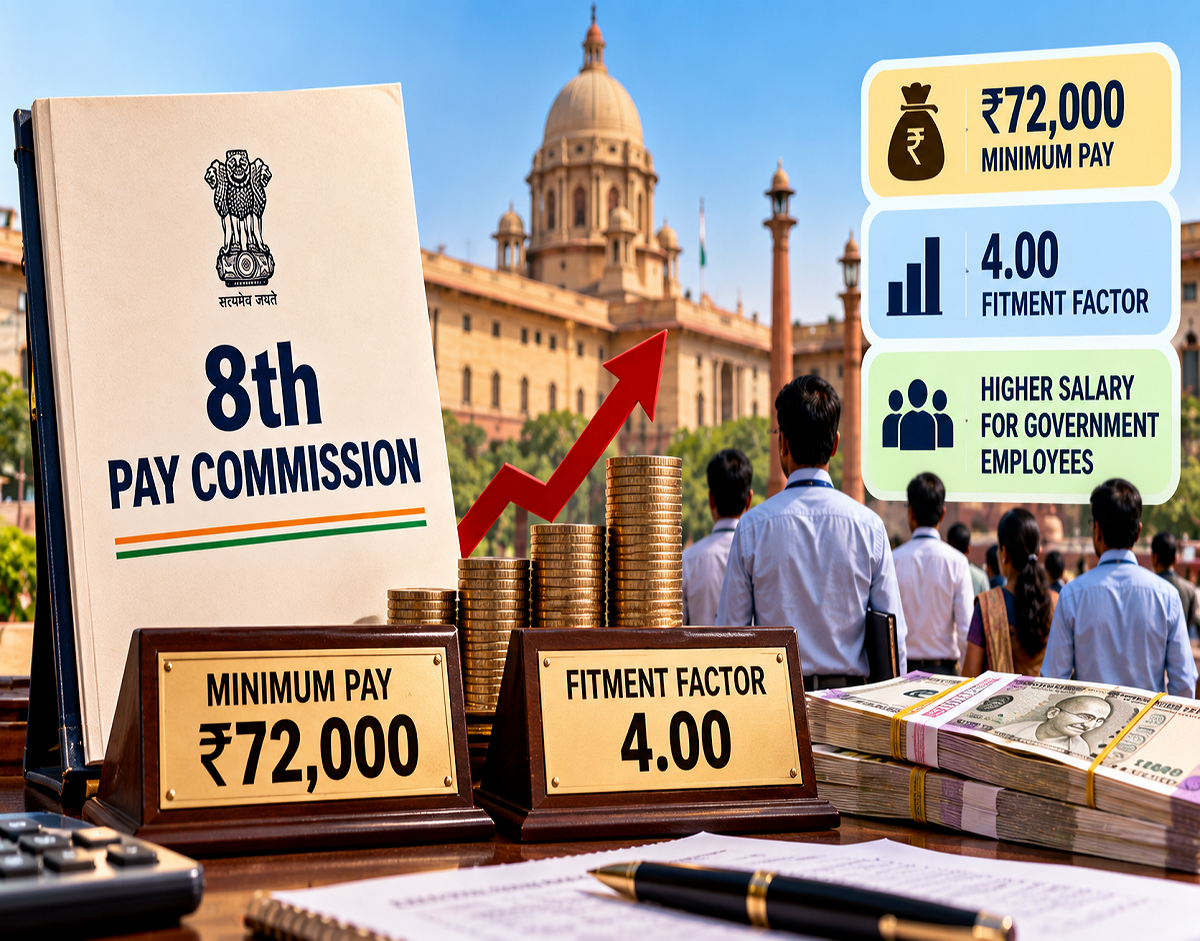
The 8th Central Pay Commission process is moving ahead, with employee organisations putting forward major proposals covering minimum basic pay, the fitment factor, annual increments and the structure of the pay matrix.
Two sets of demands have attracted particular attention. The National Council-Joint Consultative Machinery (NC-JCM) Staff Side has proposed a minimum basic pay of ₹69,000 along with a fitment factor of 3.833. Bharatiya Pratiraksha Mazdoor Sangh (BPMS), meanwhile, has proposed ₹72,000 as minimum pay with a fitment factor of 4.00.
These numbers could represent a substantial revision from the existing minimum basic pay of ₹18,000 under the 7th Pay Commission framework if adopted. However, employees and pensioners should note an important distinction: ₹69,000, ₹72,000, 3.833 and 4.00 are demands submitted by employee organisations. They have not been announced as the final rates by the government or the 8th Pay Commission.
8th Pay Commission Consultations Continue
The 8th Central Pay Commission is currently holding consultations with employee organisations, institutions, associations, unions and other stakeholders as part of its review of pay and related benefits.
After meetings in several cities, including Chennai, Puducherry and Chandigarh in September, the consultation process will continue in October.
The Commission is scheduled to visit Bengaluru on October 7 and 8, 2026, followed by Mumbai on October 22 and 23, 2026.
These meetings provide stakeholders with an opportunity to present their views on issues affecting Central Government employees and pensioners.
The Commission is headed by Justice Ranjana Prakash Desai. Prof. Pulak Ghosh serves as part-time member, while Pankaj Jain is the Member-Secretary.
NC-JCM vs BPMS: What Have They Proposed?
The two employee organisations have put forward different approaches to determining future salaries.
| Proposal | NC-JCM | BPMS |
|---|---|---|
| Proposed Minimum Basic Pay | ₹69,000 | ₹72,000 |
| Proposed Fitment Factor | 3.833 | 4.00 |
| Proposed Annual Increment | 6% | 6% |
| Current Minimum Basic Pay Reference | ₹18,000 | ₹18,000 |
These figures are proposals and should not be treated as the final salary structure under the 8th Pay Commission.
NC-JCM Seeks ₹69,000 Minimum Basic Pay
The NC-JCM Staff Side has sought a substantial increase in the minimum basic salary of Central Government employees.
Its proposal calls for minimum basic pay of ₹69,000, compared with the existing ₹18,000 minimum basic pay reference under the 7th CPC.
To support this structure, the employee side has proposed a 3.833 fitment factor.
A fitment factor is an important element in pay-revision discussions because it can be used as a multiplier while transitioning from the existing basic-pay structure to a revised one.
But simply multiplying an employee's existing salary by a figure circulating in reports should not be considered an official 8th CPC salary calculation. The final pay matrix and methodology will depend on the Commission's recommendations and subsequent government decisions.
Annual Increment of 6% Also Proposed
The fitment factor isn't the only major demand.
NC-JCM has also sought an increase in the annual increment rate from the existing 3% to 6%.
If such a proposal were eventually adopted, it would affect how basic pay progresses over an employee's service period. However, like the proposed fitment factor, the 6% annual increment remains a demand at this stage.
No final announcement should be inferred from the proposals submitted by employee organisations.
Nutrition and Household Expenses Included in NC-JCM Approach
NC-JCM has also proposed a broader methodology for calculating minimum pay.
Its recommendations include a nutrition-linked calculation based on a 3,490-calorie model, along with consideration of expenditure on areas such as housing, utilities, skill development and other household requirements.
The objective behind this approach is to argue for a minimum salary that better reflects present-day living expenses rather than relying solely on the existing pay structure.
Major Changes Proposed for Pay Levels
NC-JCM has also suggested restructuring portions of the existing pay matrix.
Among its proposals are mergers of:
Levels 2 and 3, Levels 4 and 5, Levels 7 and 8, and Levels 9 and 10.
Such changes could alter the structure of the pay matrix if eventually recommended and accepted.
However, these proposed mergers are also part of the employee side's memorandum and should not be confused with a decision already taken by the Commission.
BPMS Wants ₹72,000 Minimum Pay
BPMS has put forward a different proposal, seeking an even higher minimum basic pay.
The organisation has proposed ₹72,000 as minimum pay with a fitment factor of 4.00.
Its memorandum links the demand partly to India's growth in per-capita income.
According to figures cited in the proposal, per-capita Net National Income increased from ₹1,03,219 in 2016-17 to ₹1,92,774 in 2024-25, representing an increase of about 86.76%.
BPMS argues that wage revision should take broader economic growth and rising living costs into account.
BPMS Wants a Larger Family Unit Considered
Another notable BPMS proposal concerns the family unit used while calculating minimum wage requirements.
It has argued for considering a five-member family unit instead of three members when assessing household requirements.
The organisation's proposal uses this and other economic considerations to support its ₹72,000 minimum-pay demand.
Its suggested fitment factor of 4.00 comes from comparing the proposed ₹72,000 minimum pay with the existing ₹18,000 minimum basic pay.
Again, this is BPMS's proposed methodology—not a fitment factor announced by the government.
What Could a Higher Fitment Factor Mean?
The fitment factor has become one of the most closely watched parts of the 8th Pay Commission discussion because of its potential role in translating the existing basic-pay structure into a revised one.
For illustration, ₹18,000 multiplied by 3.833 equals approximately ₹69,000, while ₹18,000 multiplied by 4.00 equals ₹72,000.
That arithmetic explains the headline minimum-pay proposals.
It does not, however, mean every employee's eventual salary can currently be calculated by simply multiplying existing basic pay by 3.833 or 4.
The final pay matrix could depend on the Commission's methodology, rationalisation of pay levels, allowances and other decisions.
What Happens Next for Employees and Pensioners?
The most important development now is the continuation of the consultation process.
The Bengaluru meetings scheduled for October 7-8 and Mumbai meetings on October 22-23 will allow more stakeholders to engage with the Commission.
The Commission will consider representations, data and other inputs before framing its recommendations.
Therefore, Central Government employees and pensioners should distinguish carefully between union demands, Commission recommendations and final government approval.
At present, ₹69,000 and ₹72,000 are proposed minimum-pay figures. Similarly, 3.833 and 4.00 are proposed fitment factors. Neither should be reported as a confirmed salary hike.
The actual impact on basic salary, pension, allowances and take-home pay will become clearer only after the 8th Pay Commission finalises its recommendations and the Central Government takes a formal decision.