Business
8th Pay Commission: Bengaluru Talks on October 7-8 Put Salary, Pension and Fitment Demands in Focus
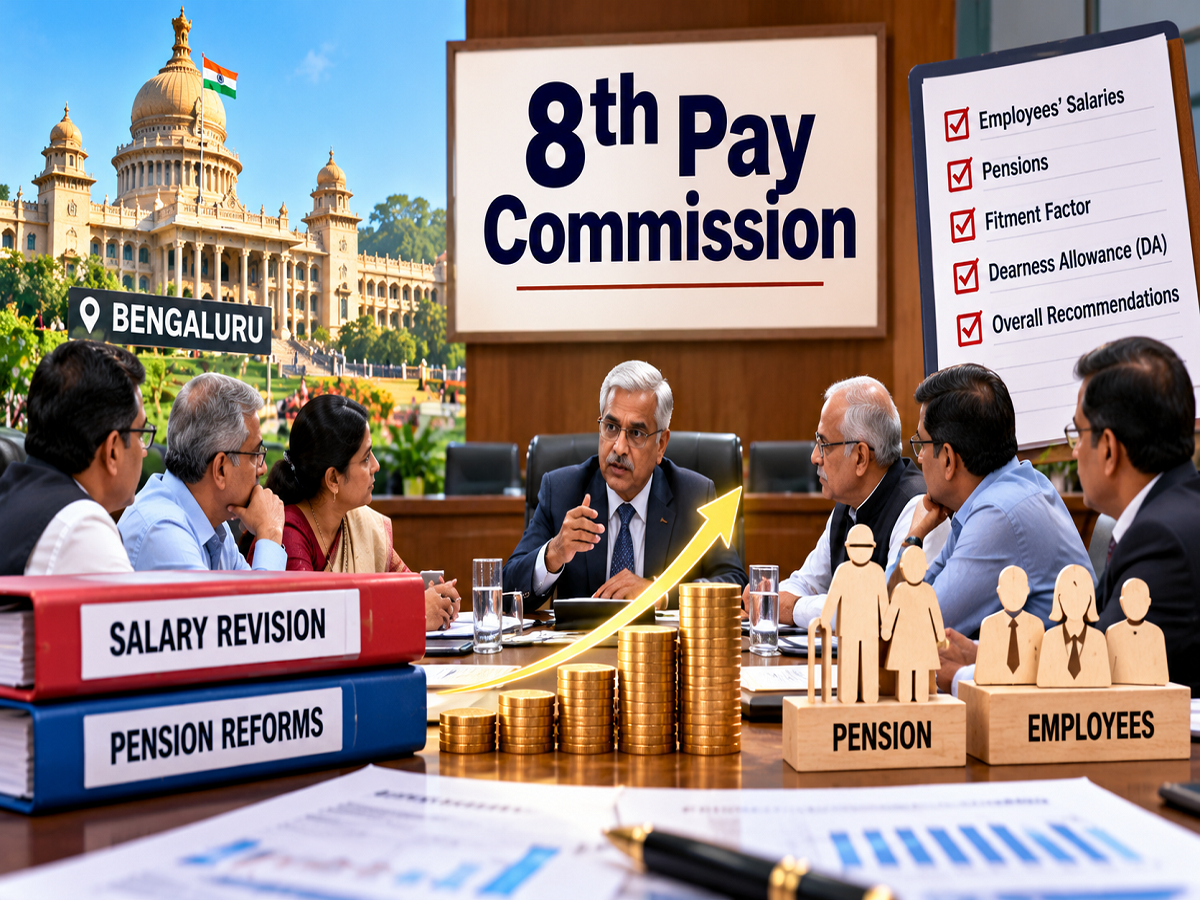
The 8th Central Pay Commission process is entering another important phase, with the Commission scheduled to visit Bengaluru on October 7 and 8, 2026, for interactions with employee associations, unions and other stakeholders.
The Bengaluru visit is officially listed by the 8th Central Pay Commission, and the deadline for eligible stakeholders to seek appointments for the interaction was September 18.
For central government employees and pensioners, attention is now turning to the demands being presented by employee organisations. These include proposals related to minimum basic pay, the fitment factor, annual increments, allowances and pension benefits.
Among the widely discussed demands are a minimum basic salary of around ₹69,000 and a fitment factor of 3.833. However, employees should note that these figures are proposals submitted by employee organisations and have not been approved by either the Pay Commission or the central government.
Here are five major issues expected to remain in focus as consultations continue.
1. Minimum Basic Pay and Fitment Factor
Salary revision is one of the biggest issues before the 8th Pay Commission.
Under the 7th Pay Commission structure, the minimum basic pay is ₹18,000 per month. Employee representatives, including the National Council-Joint Consultative Machinery (NC-JCM), have sought a substantial revision.
One of the key demands is for a 3.833 fitment factor, which would mathematically take ₹18,000 to approximately ₹69,000.
For example:
₹18,000 × 3.833 = approximately ₹69,000
The fitment factor is important because it can be used in determining revised basic pay under a new pay structure.
However, 3.833 is not the only figure being discussed. Different employee organisations have submitted different proposals. For example, BPMS has reportedly sought a 4.00 fitment factor and minimum basic pay of ₹72,000.
Therefore, claims that ₹69,000 or any other minimum salary has already been finalised are premature.
2. Demand to Increase Annual Increment From 3% to 6%
Another important issue raised by employee representatives concerns annual salary progression.
Employee organisations have sought an increase in the annual increment rate from the existing 3% to 6%.
If accepted, such a change could have a significant long-term impact because annual increments influence the progression of basic pay over an employee's service period.
But the proposed 6% increment remains a demand. No official announcement has been made confirming that annual increments will be doubled under the 8th Pay Commission.
The Commission will consider stakeholder representations before making its recommendations.
3. HRA, Transport Allowance and Other Benefits
Allowances are another major part of the compensation package for central government employees.
Representatives are expected to continue pressing for changes to House Rent Allowance (HRA), transport-related benefits, medical facilities and other allowances.
The cost of living in major urban centres is likely to feature prominently in representations made by employee groups.
Some union proposals have sought substantial changes to HRA. NC-JCM demands reported earlier include HRA slabs of 40%, 35% and 30%, linked to the applicable conditions. These numbers, too, are demands rather than approved HRA rates for the 8th Pay Commission.
Any new allowance structure will become clear only after the Commission completes its work and the government takes a decision on its recommendations.
4. Pension Revision and Commuted Pension Restoration
Pensioners are also closely watching the 8th Pay Commission consultations.
One significant demand concerns the restoration period for commuted pension.
Under the proposal put forward by employee representatives, the restoration period should be reduced from 15 years to 11 years.
Pension revision, family pension provisions and retirement benefits are also among the broader issues being raised by pensioner and employee organisations.
Any change in pension calculation or restoration rules could have financial implications for retired central government employees, which makes this one of the closely watched areas of the consultation process.
Once again, the proposed 11-year restoration period has not yet become a new rule.
5. New Formula for Calculating Minimum Pay
Employee organisations have also raised questions about how minimum pay should be calculated under the next pay structure.
One proposal involves adopting a five-unit family formula, under which dependent parents would also be considered while assessing the needs of an employee's household.
Supporters of the proposal argue that the calculation of minimum pay should reflect changes in household expenses and family responsibilities.
The five-unit approach is among the demands placed before the Commission and should not be confused with a formula that has already been accepted.
What Could Happen at the Bengaluru Meetings?
The October 7-8 Bengaluru programme is part of the Commission's wider stakeholder consultation exercise rather than an event at which a final salary revision is necessarily expected to be announced.
The Commission has been holding interactions across different parts of the country to collect representations and understand the concerns of employees, pensioners and other stakeholders.
After Bengaluru, another Commission visit is officially scheduled for Mumbai on October 22 and 23, 2026.
This means employees should be cautious about reports suggesting that the Bengaluru discussions will automatically result in an immediate announcement of a new fitment factor or revised salary.
Has ₹69,000 Minimum Salary Been Approved?
No.
The ₹69,000 figure is linked to the demand for a 3.833 fitment factor and is not an officially approved minimum salary.
The current minimum basic pay under the 7th Pay Commission is ₹18,000. Applying a 3.833 multiplier would produce a figure close to ₹69,000, but that calculation only illustrates what the union proposal could mean if it were accepted.
Similarly, the proposed 6% annual increment, five-unit family formula and reduction in the commuted pension restoration period are demands under discussion rather than confirmed benefits.
When Will Employees Know Their Actual Revised Salary?
Central government employees and pensioners will have to wait for the Commission to complete its consultation and assessment process.
The 8th Central Pay Commission was formally constituted by the Government of India through a notification dated November 3, 2025. It is chaired by Justice Ranjana Prakash Desai, with Professor Pulak Ghosh serving as part-time member and Pankaj Jain as Member-Secretary.
The Commission will eventually make recommendations on pay, pension and related service matters. The government will then consider those recommendations before the final structure is implemented.
For now, the Bengaluru visit on October 7 and 8 is an important step in the consultation process, but ₹69,000 minimum basic pay, a 3.833 fitment factor, a 6% annual increment and an 11-year commuted pension restoration period remain demands—not final government decisions.
Central government employees and pensioners should therefore rely on official Pay Commission and government announcements before treating any projected salary or pension figure as confirmed.