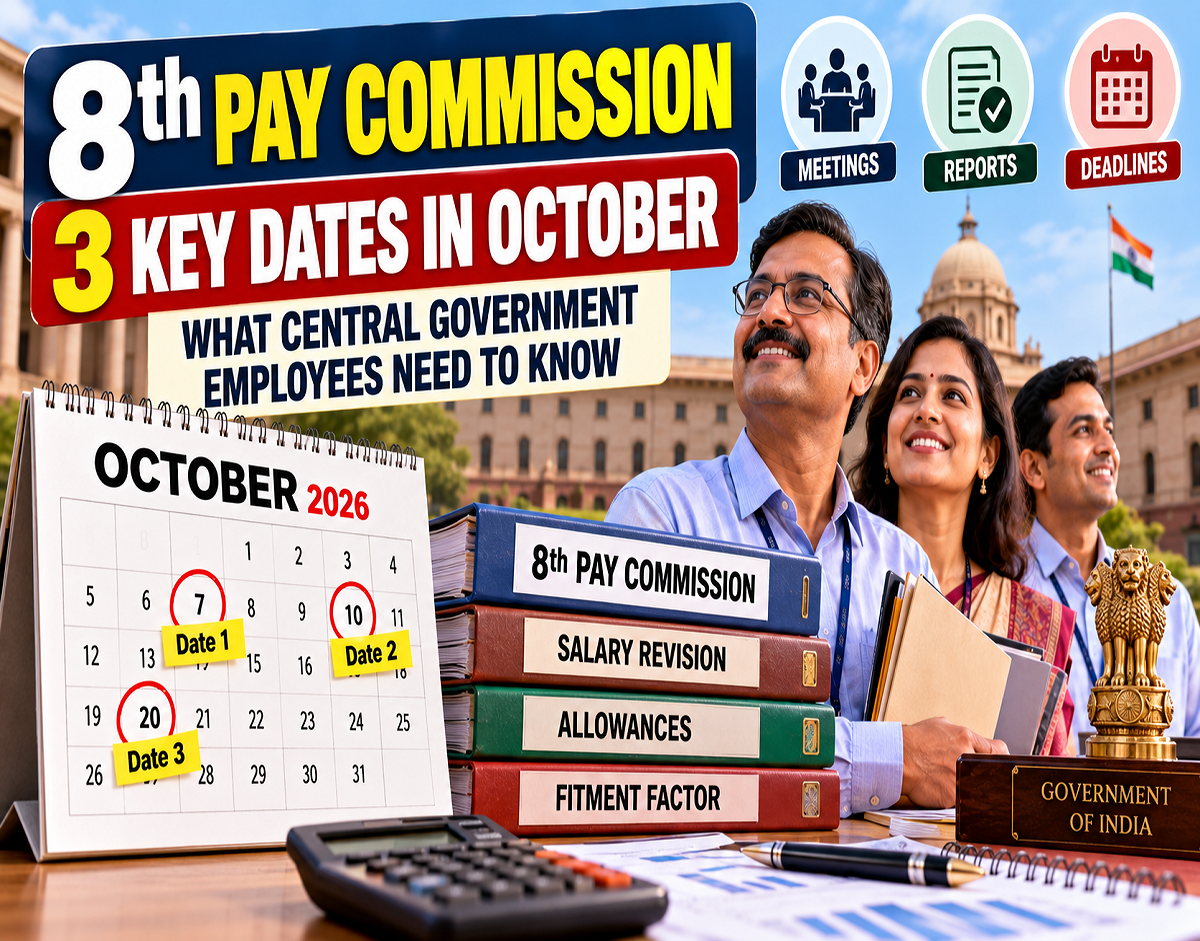
8th Pay Commission October Update: October 2026 is set to be an important month for the 8th Central Pay Commission as the panel continues consultations with employee organisations, unions and other stakeholders.
The Commission has officially scheduled visits to Bengaluru on October 7 and 8 and Mumbai on October 22 and 23. Organisations interested in participating in the Mumbai consultations have another important date to remember—October 10, which is the deadline for submitting appointment requests.
These consultations matter because the Commission is gathering views from stakeholders before preparing recommendations concerning central government pay, allowances, pensions and related service conditions.
Here are the major October dates employees and pensioners should keep an eye on.
October 7: 8th Pay Commission's Bengaluru Visit Begins
The first major date is October 7, 2026.
According to the official 8th Central Pay Commission website, the Commission will visit Bengaluru on October 7 and 8 as part of its stakeholder consultation process.
The official notice for the Bengaluru visit was issued on August 24, 2026.
Interested organisations, institutions, associations and unions of Central Government employees were invited to request an appointment with the Commission.
The purpose of these interactions is to allow stakeholders to place their views and concerns before the panel as it works on recommendations affecting government employees and pensioners.
October 8: Second Day of Bengaluru Consultations
The Bengaluru visit will continue on October 8.
The two-day exercise is part of a wider consultation programme through which the 8th Pay Commission has been engaging with stakeholders in different parts of the country.
These interactions are significant because employee and pensioner organisations can use them to present representations concerning issues such as salary structures, allowances, pension provisions and other service-related matters.
However, employees should remember that issues discussed during consultations should not be confused with final recommendations.
A demand presented by an employee organisation does not automatically become an 8th Pay Commission recommendation, and a Commission recommendation itself would still have to go through the applicable government decision-making process.
Bengaluru Registration Deadline Has Already Passed
There is an important clarification for anyone hoping to participate in the Bengaluru meetings.
The deadline for requesting an appointment for the October 7–8 Bengaluru visit was September 18, 2026.
Applicants were required to submit their appointment requests along with the Unique Memo ID generated after submission of their memorandum.
Therefore, October 10 is not the registration deadline for the Bengaluru meetings.
That date applies to the Commission's upcoming Mumbai visit.
October 10: Important Deadline for Mumbai Meeting Requests
The next important date is October 10, 2026.
The 8th Central Pay Commission has announced that it will visit Mumbai later in October, and eligible stakeholders interested in interacting with the Commission have been given until October 10 to submit their appointment requests.
This makes October 10 particularly important for eligible organisations, associations and unions seeking an opportunity to interact with the Commission during its Mumbai visit.
Individual employees should not assume that this is a general deadline requiring every central government employee to submit an application.
The appointment process is aimed at eligible stakeholders seeking formal interaction with the Commission.
October 22: Mumbai Consultations Begin
After Bengaluru, the Commission's next major October engagement is scheduled in Mumbai.
The official 8th CPC website confirms that the Commission will visit Mumbai on October 22 and October 23, 2026.
October 22 will therefore mark the first day of the Mumbai consultations.
The Commission's stakeholder engagement process provides employee organisations and other eligible groups with an opportunity to place their concerns and recommendations before the panel.
For central government employees, developments from these consultations may provide useful indications about the subjects being raised before the Commission.
They should not, however, be treated as confirmation of the final pay revision.
October 23: Second Day of Mumbai Visit
The Mumbai visit is scheduled to conclude on October 23.
By this point, the Commission will have completed two major consultation visits during October—Bengaluru and Mumbai.
These meetings form part of the broader information-gathering and consultation process before the Commission finalises its recommendations.
The official 8th CPC website also maintains a calendar covering meetings with associations and unions, ministries and departments, as well as State and Union Territory visits.
8th Pay Commission: October Calendar at a Glance
| Date | Development |
|---|---|
| October 7, 2026 | First day of Bengaluru visit |
| October 8, 2026 | Second day of Bengaluru visit |
| October 10, 2026 | Deadline for Mumbai appointment requests |
| October 22, 2026 | First day of Mumbai visit |
| October 23, 2026 | Second day of Mumbai visit |
These are official consultation-related dates. They are not dates on which a new salary, fitment factor or pension revision automatically takes effect.
What Is the 8th Pay Commission Working On?
The 8th Central Pay Commission was constituted by the Government of India through a notification dated November 3, 2025, according to the Commission's official website.
The Commission is chaired by Justice Ranjana Prakash Desai. Professor Pulak Ghosh is a part-time member, while Pankaj Jain serves as Member-Secretary.
Its work has major implications for central government employees and pensioners because a Central Pay Commission examines issues connected with remuneration and service benefits before making recommendations to the government.
Will the Bengaluru Meeting Decide the Fitment Factor?
No official information currently establishes that the October 7–8 Bengaluru meetings will finalise a fitment factor.
Numbers such as 2.57, 2.86, 3.0 and other possible multipliers frequently appear in media reports and salary illustrations, but such figures should not be presented as the officially approved 8th Pay Commission fitment factor unless the Commission or government formally announces one.
The October consultations are part of the stakeholder-engagement process.
Employees should therefore distinguish between demands made before the Commission, media estimates, Commission recommendations and final government decisions.
These are separate stages.
Will Salary Increase From October?
The October meeting calendar does not mean central government employees will automatically receive revised salaries from October 2026.
The Commission is still engaged in its consultation and recommendation process.
A revised pay structure would require the Commission's recommendations and subsequent government decisions before employees could know the actual impact on their basic pay, allowances and pensions.
Similarly, speculative salary calculators based on assumed fitment factors cannot determine the final increase.
Why These Meetings Matter for Employees and Pensioners
Although the October meetings do not themselves introduce a new salary structure, they are an important part of the Commission's work.
Stakeholder consultations allow employee organisations and other eligible groups to present evidence, proposals and concerns directly to the Commission.
Issues concerning basic pay, allowances, pension provisions and other service conditions can therefore form part of the wider consultation exercise.
The Commission can consider these representations while developing its recommendations.
That does not mean every demand presented during these meetings will be accepted.
Don't Confuse Employee Demands With Official Decisions
This distinction is particularly important as the 8th Pay Commission generates increasing interest.
Employee unions may demand a particular minimum salary, fitment factor, pension formula or allowance structure.
Those demands are legitimate inputs into the consultation process, but they are not equivalent to a Commission recommendation.
Similarly, a recommendation from the Commission does not become an implemented rule until the government takes the necessary decision.
Employees following 8th CPC developments should therefore check whether a particular figure is an employee demand, expert estimate, Commission recommendation or officially approved government decision.
Key Takeaway
October 2026 has several important dates in the 8th Pay Commission calendar.
The Commission will be in Bengaluru on October 7 and 8, while the next round of consultations in Mumbai is scheduled for October 22 and 23.
For eligible stakeholders seeking an appointment during the Mumbai visit, October 10 is the key submission deadline.
Importantly, the Bengaluru appointment deadline was September 18, so October 10 should not be described as a deadline to participate in the Bengaluru meetings.
These consultations are significant steps in the 8th Pay Commission process, but they do not mean that a fitment factor, salary increase or revised pension will be finalised on these dates. Central government employees and pensioners should continue to rely on official Commission and government announcements for confirmed pay-revision decisions.