Business
8th Pay Commission 2026: New Fitment Factor May Increase Basic Salary, HRA and Other Benefits
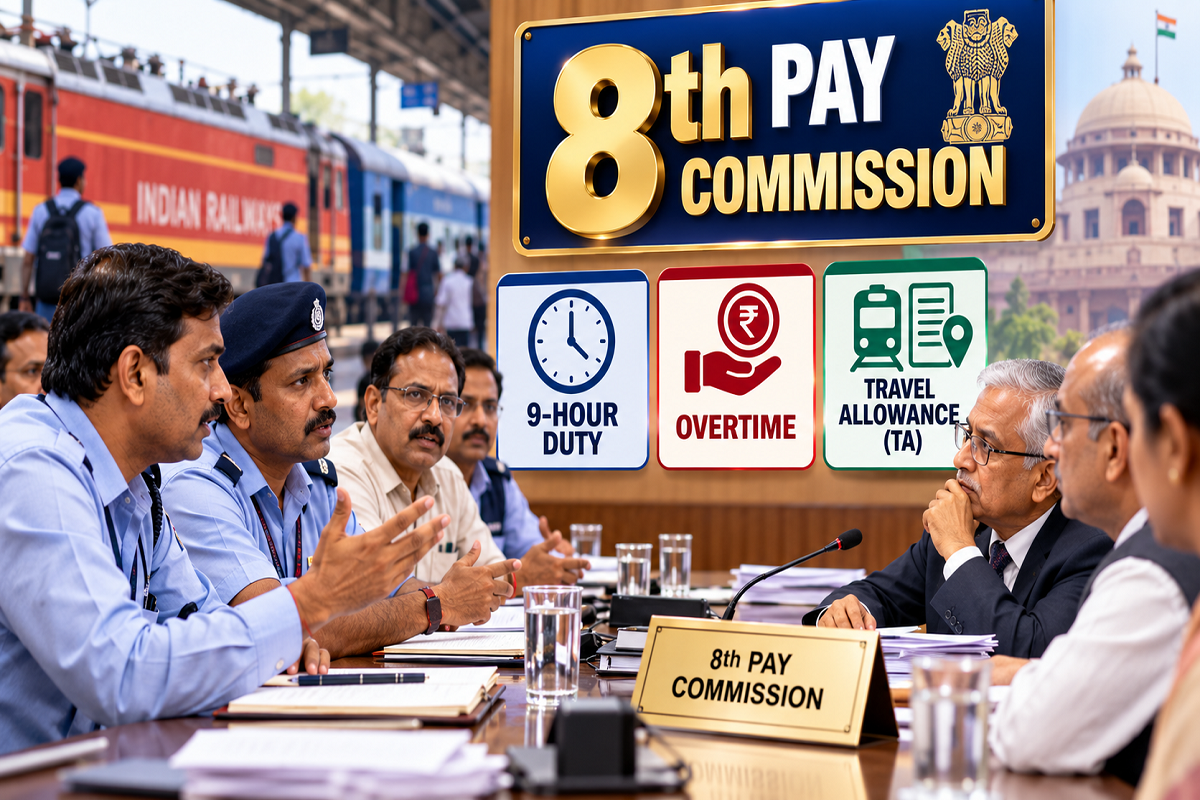
8th Pay Commission Latest Update 2026: Central government employees and pensioners are closely watching developments related to the 8th Central Pay Commission. One of the biggest questions is how much basic salaries could increase once the government approves a new fitment factor.
The fitment factor is particularly important because it helps determine revised basic pay. Any increase in basic salary could also influence other salary components, including House Rent Allowance (HRA), subject to the rules approved under the new pay structure.
According to reports, members of the 8th Pay Commission visited Mumbai on October 22 and 23, 2026, to interact with employee representatives, trade unions, pensioners' organisations and other stakeholders.
The commission is gathering feedback before preparing its recommendations for the Central Government.
Employee organisations have reportedly demanded a fitment factor ranging from 3.83 to 4.00. However, these figures remain demands rather than approved government decisions.
Here is how different fitment factors could affect basic salaries and other benefits.
What Is the Latest Update on the 8th Pay Commission?
The 8th Central Pay Commission is expected to examine the pay structure and related benefits of eligible central government employees.
Its recommendations may cover basic pay, allowances, pensions and other service-related financial matters.
The commission's consultations with employee organisations and pensioner representatives are an important part of this process.
Reports suggest that the commission may submit its recommendations during 2027, although the actual submission and implementation schedules will depend on official decisions.
The final salary increase will become clear only after the commission submits its recommendations and the Central Government takes a decision.
What Is the Fitment Factor?
The fitment factor is a multiplier used to calculate revised basic pay under a new pay structure.
It is one of the most closely watched aspects of a pay commission because it can significantly change the salary matrix.
For example, if an employee currently receives ₹18,000 as basic pay and a fitment factor of 2.00 is applied, the illustrative revised basic pay would be:
₹18,000 × 2.00 = ₹36,000
Similarly, a fitment factor of 2.57 would produce an illustrative basic pay of ₹46,260.
However, these are simple mathematical projections.
The final basic salary may depend on the approved pay matrix, rounding rules, pay-level placement and other implementation provisions.
What Fitment Factor Are Employees Demanding?
Employee unions and pensioners' associations have reportedly sought a fitment factor between 3.83 and 4.00.
Such a multiplier would result in a substantial increase in the calculated basic pay.
However, some estimates discussed by analysts suggest lower possible multipliers, including figures around 1.83 to 2.86.
These numbers should not be treated as confirmed recommendations.
As of October 28, 2026, no final fitment factor for the 8th Pay Commission has been approved.
The commission's recommendations and the government's subsequent decision will determine the actual multiplier.
8th Pay Commission Salary Calculation: Check Different Fitment Factors
The following table illustrates how existing basic salaries could change under different hypothetical fitment factors.
Expected Basic Salary Under Different Fitment Factors
| Pay Level | Current Basic Pay | Factor 1.83 | Factor 2.00 | Factor 2.57 | Factor 3.83 | Factor 4.00 |
|---|---|---|---|---|---|---|
| Level 1 | ₹18,000 | ₹32,940 | ₹36,000 | ₹46,260 | ₹68,940 | ₹72,000 |
| Level 2 | ₹19,900 | ₹36,417 | ₹39,800 | ₹51,143 | ₹76,217 | ₹79,600 |
| Level 3 | ₹21,700 | ₹39,711 | ₹43,400 | ₹55,769 | ₹83,111 | ₹86,800 |
| Level 4 | ₹25,500 | ₹46,665 | ₹51,000 | ₹65,535 | ₹97,665 | ₹1,02,000 |
| Level 5 | ₹29,200 | ₹53,436 | ₹58,400 | ₹75,044 | ₹1,11,836 | ₹1,16,800 |
| Level 6 | ₹35,400 | ₹64,782 | ₹70,800 | ₹90,978 | ₹1,35,582 | ₹1,41,600 |
| Level 7 | ₹44,900 | ₹82,167 | ₹89,800 | ₹1,15,393 | ₹1,71,967 | ₹1,79,600 |
| Level 8 | ₹47,600 | ₹87,108 | ₹95,200 | ₹1,22,332 | ₹1,82,308 | ₹1,90,400 |
| Level 9 | ₹53,100 | ₹97,173 | ₹1,06,200 | ₹1,36,467 | ₹2,03,373 | ₹2,12,400 |
| Level 10 | ₹56,100 | ₹1,02,663 | ₹1,12,200 | ₹1,44,177 | ₹2,14,863 | ₹2,24,400 |
Note: These are illustrative calculations based on multiplication of existing basic pay. They are not an official 8th Pay Commission pay matrix or approved salary figures.
How Will the New Basic Pay Affect HRA?
House Rent Allowance is an important salary component for eligible central government employees.
Under the existing framework, HRA depends on basic pay and the classification of the city where an employee is posted.
Cities are divided into X, Y and Z categories.
The applicable HRA percentage varies according to the category.
Currently, the commonly applicable HRA rates are:
| City Category | HRA Rate |
|---|---|
| X category | 30% of basic pay |
| Y category | 20% of basic pay |
| Z category | 10% of basic pay |
X-category cities generally include designated major metropolitan areas.
Y-category cities include other designated urban centres, while Z-category locations cover the remaining eligible areas.
The exact classification follows government notifications.
HRA Calculation After Basic Salary Revision
Suppose an employee currently earns ₹18,000 as basic salary.
At the existing 30% HRA rate for an X-category city, the monthly HRA would be ₹5,400.
Now assume the employee's revised basic salary becomes ₹36,000 under a hypothetical fitment factor of 2.00.
If the 30% HRA rate remains unchanged, the new HRA would be ₹10,800.
This would mean an increase of ₹5,400 in monthly HRA.
HRA Calculation at ₹36,000 Basic Pay
| City Category | Assumed HRA Rate | Monthly HRA |
|---|---|---|
| X | 30% | ₹10,800 |
| Y | 20% | ₹7,200 |
| Z | 10% | ₹3,600 |
These figures assume the existing HRA percentages continue after the new pay structure is implemented.
The 8th Pay Commission may recommend different HRA rules, so the actual amount could vary.
HRA Comparison at Different Fitment Factors
Consider an employee with an existing basic salary of ₹18,000.
If different fitment factors are applied, the revised basic pay and corresponding HRA could look like this.
| Fitment Factor | Illustrative Basic Pay | HRA at 30% | HRA at 20% | HRA at 10% |
|---|---|---|---|---|
| 1.83 | ₹32,940 | ₹9,882 | ₹6,588 | ₹3,294 |
| 2.00 | ₹36,000 | ₹10,800 | ₹7,200 | ₹3,600 |
| 2.57 | ₹46,260 | ₹13,878 | ₹9,252 | ₹4,626 |
| 3.83 | ₹68,940 | ₹20,682 | ₹13,788 | ₹6,894 |
| 4.00 | ₹72,000 | ₹21,600 | ₹14,400 | ₹7,200 |
This table shows why employees are closely watching both the fitment factor and the future HRA rules.
However, the figures should not be interpreted as confirmed benefits.
What Will Happen to Dearness Allowance?
Dearness Allowance is another major component of central government salaries.
Following the October 2026 revision, the DA rate has increased from 60% to 63%, effective July 1, 2026.
When a new pay commission's recommendations are implemented, the treatment of existing DA becomes an important part of the revised salary structure.
Under the previous pay commission transition, the DA rate was reset when the revised pay structure took effect.
A similar approach may be considered under the 8th Pay Commission, but the final decision will depend on the approved recommendations and implementation orders.
Employees should not assume that the existing 63% DA will automatically continue on top of the fully revised basic pay.
Which Other Benefits Could Be Affected?
Apart from HRA, changes to basic pay may affect several salary-related calculations.
These could include retirement contributions, gratuity-related calculations and other benefits that are linked to basic pay or the applicable pay structure.
However, not every allowance will necessarily increase by the same percentage.
Some benefits are fixed amounts, while others are governed by separate eligibility conditions and government orders.
The commission may recommend changes to certain allowances, but the final structure will be known only after government approval.
How Did the 7th Pay Commission Change Salaries?
The 7th Central Pay Commission introduced a fitment factor of 2.57.
Under that pay revision, the minimum basic salary increased from ₹7,000 to ₹18,000.
The revised pay structure also introduced the pay matrix used for central government employees.
This historical example explains why employees are paying close attention to the fitment factor under the 8th Pay Commission.
However, the multiplier used under the previous commission does not guarantee a similar outcome this time.
Will Pensioners Also Benefit?
The 8th Pay Commission's recommendations are also important for eligible central government pensioners.
Changes in pension calculation or revision rules could affect their retirement income.
Pensioner organisations have raised demands concerning the fitment factor and other benefits.
However, the actual impact on pensions will depend on the recommendations accepted by the Central Government.
Pensioners should wait for official notifications rather than relying on projected pension tables circulated online.
When Will the 8th Pay Commission Be Implemented?
The commission is undertaking consultations and reviewing matters related to pay and benefits.
Reports have suggested that its recommendations could be submitted in 2027.
However, the submission of a report and implementation of a revised pay structure are separate stages.
After receiving the recommendations, the government must examine them and decide which proposals to accept.
The effective date, payment arrangements and any arrears will depend on the final government orders.
Final Update
The 8th Pay Commission could bring important changes to basic salaries, House Rent Allowance and other benefits for eligible central government employees.
Employee organisations have demanded a fitment factor of up to 4.00, while several other figures are being discussed as possible scenarios.
However, no final fitment factor or revised pay matrix has been approved as of October 28, 2026.
If basic salaries increase, HRA could also rise, depending on the rates and rules adopted under the new pay structure.
Employees and pensioners should follow official announcements for confirmed details rather than treating speculative calculations as guaranteed salary increases.
Disclaimer: All salary and HRA projections in this article are illustrative. Actual benefits will depend on the final 8th Pay Commission recommendations and government approval.