
Business
8th Pay Commission 2026: 3.833 Fitment Factor, 6% Annual Increment and January Arrears—Latest Update
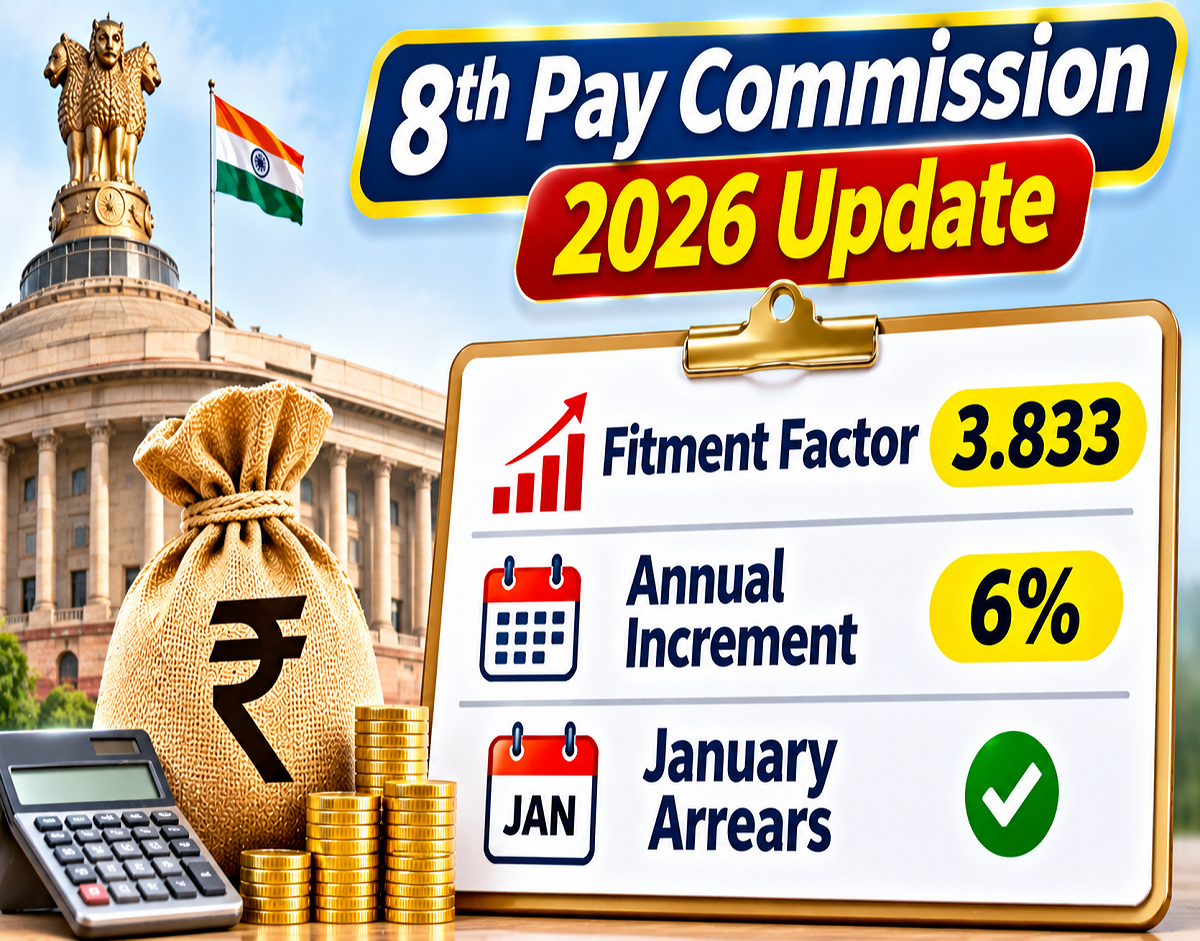
8th Pay Commission Latest News 2026: Central government employees and pensioners are closely watching developments surrounding the 8th Central Pay Commission, particularly proposals concerning salary increases, pension revisions, annual increments and arrears.
The Staff Side of the National Council–Joint Consultative Machinery (NC-JCM) has reportedly proposed a uniform fitment factor of 3.833 for revising basic salaries and pensions. If accepted, this multiplier could raise the minimum basic salary of central government employees from ₹18,000 to approximately ₹69,000 per month.
Employee representatives have also demanded an increase in the annual salary increment rate from 3% to 6%, along with changes to the existing pay matrix.
However, the government has not approved the proposed fitment factor, higher annual increments or the final implementation date.
Shiv Gopal Mishra, Secretary of the NC-JCM Staff Side and a key representative of central government employees, has acknowledged that the outcome of the fitment factor proposal remains uncertain.
8th Pay Commission: What Did Shiv Gopal Mishra Say?
According to a report attributed to NDTV, Shiv Gopal Mishra said that the 8th Pay Commission had listened to the employee representatives' demands and considered their submissions.
He explained that the Staff Side had presented its proposals with supporting calculations and arguments.
However, when asked whether the commission would accept the proposed fitment factor of 3.833, Mishra declined to predict the outcome.
His remarks indicate that discussions have taken place, but no final decision has been announced regarding the salary revision formula.
This distinction is important because a demand submitted by employee organisations does not automatically become an approved government policy.
8th Pay Commission Salary Hike: Minimum Basic Pay May Reach ₹69,000
One of the most discussed proposals concerns the revision of minimum basic salary.
Under the 7th Pay Commission, the minimum basic pay for central government employees was fixed at ₹18,000 per month.
The NC-JCM Staff Side has reportedly requested a uniform multiplication factor of 3.833.
If the proposed factor is applied directly to the existing minimum basic salary, the calculation would be:
Illustrative minimum basic salary calculation
Existing Basic Pay
₹18,000
Proposed Fitment Factor
3.833
₹18,000 × 3.833
₹68,994
Approximately ₹69,000 per month. This is a demand-based illustration, not an approved pay scale.
The calculation represents a substantial increase in basic pay. However, it should not be interpreted as an equivalent increase in take-home salary.
Dearness Allowance (DA), House Rent Allowance (HRA), deductions and other components must be considered separately.
The final salary structure will depend on the recommendations accepted by the government.
What Is the Fitment Factor in the 8th Pay Commission?
A fitment factor is a multiplier used to calculate revised basic pay under a new pay commission.
It helps convert existing salary levels into a revised pay structure.
For example, the 7th Pay Commission recommended a fitment factor of 2.57.
Employee organisations are now seeking a considerably higher multiplier for the 8th Pay Commission.
The NC-JCM Staff Side has reportedly proposed 3.833, while some other employee associations have suggested factors ranging from 3.61 to 4.00.
These figures remain proposals rather than officially approved rates.
8th Pay Commission Salary Calculator: Check Different Fitment Factors
The following table illustrates how basic pay could change under different hypothetical multipliers.
| Current Basic Pay | Factor 2.57 | Factor 3.00 | Factor 3.833 |
|---|---|---|---|
| ₹18,000 | ₹46,260 | ₹54,000 | ₹68,994 |
| ₹25,500 | ₹65,535 | ₹76,500 | ₹97,742 |
| ₹35,400 | ₹90,978 | ₹1,06,200 | ₹1,35,688 |
| ₹44,900 | ₹1,15,393 | ₹1,34,700 | ₹1,72,102 |
| ₹56,100 | ₹1,44,177 | ₹1,68,300 | ₹2,15,031 |
All figures are mathematical illustrations. They do not represent an approved 8th Pay Commission pay matrix.
Employees can also use the calculator below to explore different scenarios.
Illustrative Revised Monthly Basic Pay
₹68,994
Subject to government approval and the final pay matrix
Current Basic Salary (₹)
Fitment Factor
3.833
Existing Basic Pay
₹18,000
Illustrative Increase
₹50,994
Percentage Increase in Basic Pay
283.3%
Reset Calculator
Annual Salary Increment May Increase From 3% to 6%
Another important demand concerns the annual increment rate.
Under the existing pay structure, annual increments are generally calculated at 3% within the applicable pay matrix framework.
Employee representatives have reportedly requested an increase to 6%.
If approved, this could lead to faster growth in basic salary over the course of an employee's career.
For example, consider an illustrative basic salary of ₹50,000.
A simple 3% increase would equal ₹1,500, while a 6% increase would equal ₹3,000.
| Particulars | Existing 3% | Proposed 6% |
|---|---|---|
| Illustrative Basic Pay | ₹50,000 | ₹50,000 |
| Annual Increment | ₹1,500 | ₹3,000 |
| Basic Pay After Increase | ₹51,500 | ₹53,000 |
Actual increments under the government pay matrix are determined through the applicable rules and pay levels, so the example is intended only to demonstrate the percentage difference.
The 6% increment proposal has not yet received government approval.
NC-JCM Demands Changes to the Pay Matrix
The Staff Side has also reportedly recommended simplifying the existing pay matrix.
One proposal involves merging certain pay levels to address perceived disparities in the salary structure.
The suggested combinations include:
- Pay Levels 2 and 3
- Pay Levels 4 and 5
- Pay Levels 7 and 8
- Pay Levels 9 and 10
Employee representatives have additionally proposed a one-time upgrade from Level 5 to Level 6 for eligible employees.
Another demand concerns simplifying the pay matrix up to Level 13.
These suggestions would require detailed examination because changes to pay levels can affect salaries, promotions, allowances and career progression.
No final decision has been announced on these proposals.
Minimum Salary Calculation Based on a Five-Member Family
The NC-JCM Staff Side has reportedly proposed calculating minimum wages by considering the requirements of a five-member family.
According to the supplied report, the proposal takes into account nutritional requirements, housing expenses, electricity, water and other essential household costs.
The representatives have referred to a daily dietary requirement of 3,490 kilocalories under the methodology cited in their submission.
The intention is to develop a minimum salary calculation that reflects household expenditure and living standards.
However, the commission must evaluate the submissions before recommending any revised minimum pay structure.
8th Pay Commission Arrears: Will Employees Receive Payments From January 2026?
Arrears are another major concern for central government employees and pensioners.
Shiv Gopal Mishra has reportedly expressed strong confidence that revised salaries and pensions will be implemented retrospectively from January 1, 2026.
According to the report, he said he was fully confident that arrears would be calculated from that date.
However, this remains the expectation of an employee representative, not an official government commitment.
The central government has not yet formally notified the effective date for the revised pay structure.
The final decision will depend on the commission's recommendations, government examination and subsequent approval.
How Could Arrears Be Calculated?
Arrears generally represent the difference between the revised entitlement and the amount already paid for a particular period.
For example, if a revised basic salary is implemented retrospectively, the calculation may involve determining the difference between the old and new payable amounts for each eligible month.
The actual arrears could also depend on DA treatment, allowances, deductions, implementation rules and the officially approved effective date.
Therefore, it would be premature to calculate a confirmed arrears amount before the government announces the final pay structure.
Why Are Employees Expecting January 1, 2026, as the Effective Date?
The 7th Pay Commission's pay structure took effect from January 1, 2016.
Although the Union Cabinet approved the recommendations later in 2016, the revised pay structure was implemented retrospectively.
This precedent has contributed to expectations that the 8th Pay Commission could also have a retrospective implementation date.
Employee organisations consider January 1, 2026, a natural reference point for the next revision cycle.
However, the government is not automatically bound to follow the same implementation arrangement.
The effective date and arrears provisions will become clear only after an official decision.
When Will the 8th Pay Commission Submit Its Report?
The 8th Central Pay Commission was constituted through a notification dated November 3, 2025.
The commission is chaired by former Supreme Court judge Justice Ranjana Prakash Desai.
Professor Pulak Ghosh serves as a part-time member, while Pankaj Jain is the Member-Secretary.
The commission has been given 18 months to submit its report.
Based on this timeline, the report is expected around May 2027, subject to the commission's progress and any official changes.
The report states that regional consultations with stakeholders have been conducted, including a meeting in Bengaluru.
After receiving the recommendations, the government will need to examine the financial and administrative implications before taking a final decision.
What Is the Government's Position on Salary Hike and Arrears?
The government has not announced a final fitment factor or revised salary structure.
Similarly, there has been no official confirmation of the proposed 6% annual increment or retrospective arrears from January 2026.
The commission's recommendations will be considered through the appropriate government decision-making process.
Only after approval will the revised pay matrix, implementation date and applicable benefits become official.
Employees and pensioners should therefore distinguish between demands raised by representative organisations and decisions formally notified by the government.
8th Pay Commission Latest Update: What Employees Should Remember
The NC-JCM Staff Side's proposed fitment factor of 3.833 could mathematically increase the minimum basic salary from ₹18,000 to approximately ₹69,000 per month.
The representatives have also demanded doubling annual increments from 3% to 6%, simplifying pay levels and revising minimum wage calculations.
On arrears, Shiv Gopal Mishra has expressed confidence that the revised benefits will apply from January 1, 2026.
However, none of these proposals has yet been confirmed as the final government-approved framework.
Central government employees and pensioners will need to wait for the 8th Pay Commission's recommendations and the government's subsequent decisions to know the actual salary increase, pension revision and arrears entitlement.