Business
Special FD vs Regular FD: Where Should You Put ₹10 Lakh? Check Returns, Tax and Early-Exit Cost
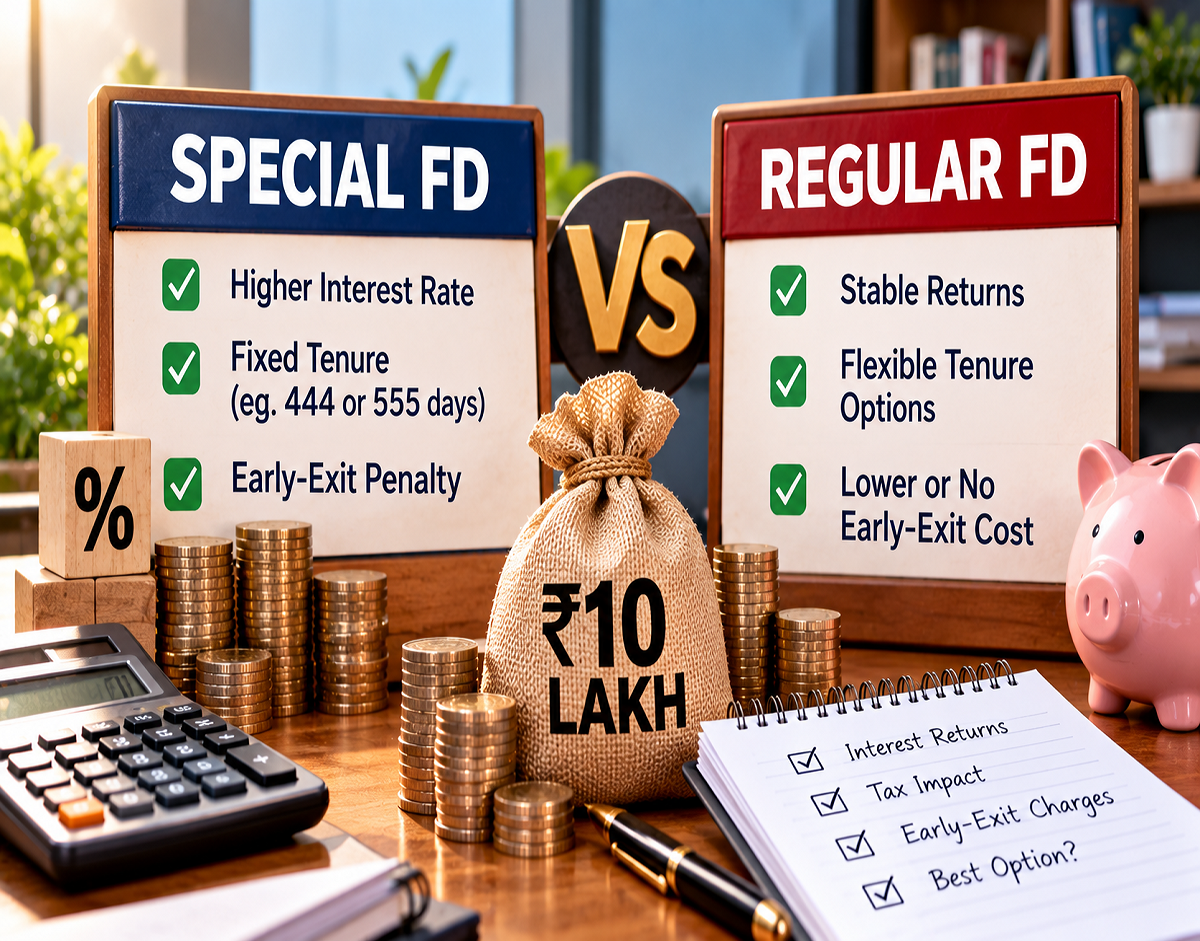
Special fixed deposits with unusual tenures such as 444 days or 555 days often attract attention because banks may offer slightly higher interest rates than their standard FD plans. An additional 0.15% to 0.25% may appear attractive, particularly when a large amount is being invested.
But the headline interest rate does not tell the complete story.
The actual advantage of a special FD can shrink after income tax is considered. More importantly, if the deposit has to be closed before maturity, the applicable premature-withdrawal rules can potentially wipe out the additional return.
An illustration involving a ₹10 lakh deposit shows why investors should compare more than just the advertised rate before choosing between a special-tenure FD and a regular fixed deposit.
Special FD vs Regular FD: How Big Is the Rate Difference?
Consider an example where a 444-day special FD offers an interest rate of 6.45%, while a comparable regular FD carries a rate of 6.25%.
The difference is only 20 basis points, or 0.20 percentage point.
At first glance, earning an extra 0.20% on ₹10 lakh may seem worthwhile. However, the actual benefit needs to be calculated for the applicable tenure and then adjusted for the investor's tax liability.
The source analysis indicates that for an investor in the 30% income-tax slab, the incremental post-tax benefit on the ₹10 lakh example can be only around ₹1,810.
That makes liquidity an important part of the decision.
Why Tax Can Reduce the Advantage
Interest earned from bank fixed deposits is generally taxable according to the investor's applicable income-tax rules.
This means a higher FD rate does not automatically translate into the same increase in take-home returns.
Suppose the special FD produces some additional interest compared with a regular deposit. An investor in a higher tax bracket may have to pay tax on that incremental interest as well, reducing the effective advantage.
For someone in the 30% tax slab, the difference between two FD options separated by only 20 basis points can therefore become relatively small after tax.
This does not make a special FD unattractive by itself. It simply means the investor should compare post-tax returns, not only advertised interest rates.
Premature Withdrawal Can Change the Entire Calculation
The biggest issue can arise if the investor needs the money before the special FD reaches maturity.
Suppose ₹10 lakh is invested in the example special FD carrying a 6.45% rate, but an emergency forces the depositor to close it after one year instead of waiting for the full special tenure.
The investor may not receive the originally advertised 6.45% rate for that one-year holding period.
According to the example provided, the applicable regular one-year rate would be 6.25%. A premature-withdrawal penalty may then be deducted from the applicable rate.
Assuming a 0.50 percentage point penalty:
Applicable one-year rate: 6.25%
Premature-withdrawal penalty: 0.50%
Illustrative effective rate: 5.75%
The source calculation estimates interest of approximately ₹58,752 after one year under this premature-closure scenario.
How ₹5,228 Could Be Lost by Exiting Early
Now compare that with an investor who had selected a regular one-year FD from the beginning.
At the illustrative 6.25% rate, the source calculates interest of approximately ₹63,980 after one year.
The difference works out to:
₹63,980 − ₹58,752 = ₹5,228
In this example, choosing the special FD and then closing it after one year leaves the investor approximately ₹5,228 worse off than if a regular one-year FD had been selected initially.
The important lesson is that a special FD's higher headline rate can be useful only when the investor can reasonably remain invested for the required tenure.
Actual premature-withdrawal calculations vary by bank, deposit amount, tenure and applicable terms, so depositors should check the bank's current rules before investing.
Why the Word 'Special' Doesn't Always Mean the Highest Return
Investors should also avoid assuming that a product labelled a "special FD" automatically offers the best available interest rate.
Different banks can offer substantially different rates.
One bank's regular FD could potentially offer a rate comparable with, or even better than, another institution's special-tenure deposit. Senior citizens may also receive additional interest depending on the bank and scheme.
Instead of looking only at the product name, investors should compare:
- Interest rate and effective annual return
- Exact maturity period
- Premature-withdrawal rules
- Applicable penalty
- Tax impact
- Liquidity requirements
- Bank-specific terms
A slightly higher rate may not compensate for an inconvenient maturity period if there is a meaningful possibility that the money will be required earlier.
When Can a Special FD Make Sense?
A special-tenure fixed deposit may be worth considering for money that an investor is reasonably confident will not be required before maturity.
For example, someone with a separate emergency fund and adequate liquidity elsewhere may be more comfortable locking money into a 444-day or 555-day deposit.
If the special FD genuinely offers a higher rate than comparable alternatives and the investor can stay until maturity, the additional interest can be useful.
The key is matching the investment tenure with the expected requirement for the money.
When Could a Regular FD Be More Suitable?
A regular fixed deposit may provide greater flexibility for investors who want to choose a familiar tenure such as one, two or three years.
It can also be easier to align the maturity date with a known financial requirement.
Someone who expects to need the money after approximately one year, for example, should carefully consider whether locking it into a 444-day or 555-day special FD merely to earn a marginally higher rate is worthwhile.
Choosing an appropriate tenure from the beginning can help reduce the risk of premature-withdrawal penalties.
Don't Ignore Deposit Insurance
Safety is another important factor when comparing bank deposits.
Eligible bank deposits are covered under the Deposit Insurance and Credit Guarantee Corporation (DICGC) framework.
The insurance cover is up to ₹5 lakh per depositor per bank, combining eligible principal and interest, subject to applicable rules.
Therefore, someone placing ₹10 lakh in a single bank should not interpret the DICGC provision as insurance covering the entire ₹10 lakh deposit.
Investors placing larger sums in FDs may want to understand the deposit-insurance limit while deciding how to distribute their money.
Special FD or Regular FD: Focus on the Effective Return
The comparison shows why the highest advertised FD rate should not be the only factor in a deposit decision.
In the ₹10 lakh example, a 0.20 percentage-point higher special-FD rate can translate into a relatively modest incremental benefit after tax for an investor in the 30% slab. Meanwhile, having to close the deposit after one year could create an illustrative disadvantage of around ₹5,228 compared with choosing the one-year regular FD from the outset.
A special FD can therefore be useful when its maturity period matches the investor's financial plan. A regular FD may offer a better fit when flexibility or a specific maturity date is more important.
Before investing, compare the post-tax return, maturity period, premature-withdrawal penalty and liquidity requirement rather than making the decision solely on the extra interest advertised by the bank.
Disclaimer: The calculations in this article are illustrative and based on the rates and assumptions provided in the source. Actual FD rates, compounding methods, taxation and premature-withdrawal penalties can vary by bank and investor. Check the latest terms with the relevant bank and consider professional financial or tax advice before making an investment decision.