Business
₹5,000 Monthly SIP Could Grow to ₹16.45 Lakh in 10 Years: Direct vs Regular Mutual Fund Plans Explained

SIP Investment 2026: Investing just ₹5,000 every month in a mutual fund can create substantial wealth over time. But did you know that choosing the right investment plan can make a difference of more than ₹1 lakh without increasing your monthly contribution? A comparison of India's five largest midcap mutual funds shows how direct plans have delivered higher returns than regular plans over the past decade.
According to ACE MF data reported by Moneycontrol, a monthly SIP of ₹5,000 started 10 years ago would have required a total investment of ₹6 lakh. By October 28, 2026, this investment could have grown to between ₹13.53 lakh and ₹16.45 lakh, depending on the fund and plan selected.
Interestingly, the direct plans of all five mutual funds generated higher maturity values than their regular counterparts. The difference ranged from ₹66,194 to ₹1,09,050, highlighting how investment costs can influence long-term wealth creation.
How ₹5,000 Monthly SIP Can Create a Fund of ₹16.45 Lakh
A Systematic Investment Plan (SIP) allows individuals to invest a fixed amount in mutual funds at regular intervals, usually every month.
For example, suppose an investor started a ₹5,000 monthly SIP in their wife's name in October 2016 and continued investing for 10 years.
The investment calculation would look like this:
- Monthly SIP amount: ₹5,000
- Investment duration: 10 years
- Total monthly instalments: 120
- Total amount invested: ₹6,00,000
- Highest reported portfolio value: ₹16,45,660
- Wealth gained above investment: ₹10,45,660
This highest portfolio value was recorded in the direct plan of Motilal Oswal Midcap Fund, according to the historical comparison.
These figures are based on past fund performance and should not be considered guaranteed returns.
Direct vs Regular SIP: Which Plan Generated More Wealth?
The comparison covers five major midcap mutual funds selected on the basis of their assets under management (AUM).
Here is how a ₹5,000 monthly SIP performed over 10 years under direct and regular plans.
| Mutual Fund | Direct Plan Value | Regular Plan Value | Extra Wealth |
|---|---|---|---|
| HDFC Mid Cap Fund | ₹15,55,376 | ₹14,89,182 | ₹66,194 |
| Kotak Mid Cap Fund | ₹15,07,650 | ₹14,01,371 | ₹1,06,279 |
| Nippon India Growth Mid Cap Fund | ₹16,16,222 | ₹15,38,961 | ₹77,261 |
| Motilal Oswal Midcap Fund | ₹16,45,660 | ₹15,36,610 | ₹1,09,050 |
| Axis Midcap Fund | ₹14,56,430 | ₹13,53,194 | ₹1,03,236 |
Source: ACE MF data published by Moneycontrol; values as of October 28, 2026. Historical SIP calculations.
Motilal Oswal Midcap Fund delivered the highest final value among the five direct plans in this comparison.
Meanwhile, Kotak and Axis recorded particularly noticeable differences between their direct and regular investment options.
Why Do Direct Mutual Fund Plans Offer Higher Returns?
The main reason behind the difference is the expense ratio.
Every mutual fund charges expenses for managing investments, administration and other operating activities. These charges are reflected in the fund's net asset value (NAV).
A regular mutual fund plan generally includes distribution-related expenses, while a direct plan does not include distributor commissions.
As a result, direct plans typically have lower expense ratios.
Both versions of the same scheme invest in the same underlying portfolio and follow the same investment strategy. However, lower expenses can help the direct plan retain a greater portion of investment returns.
Over several years, even a small annual difference can become significant because of compounding.
How Much Extra Money Did Direct SIP Investors Earn?
The historical comparison shows that investors could have accumulated considerably more wealth simply by selecting the direct version of the same scheme.
Additional portfolio value after 10 years
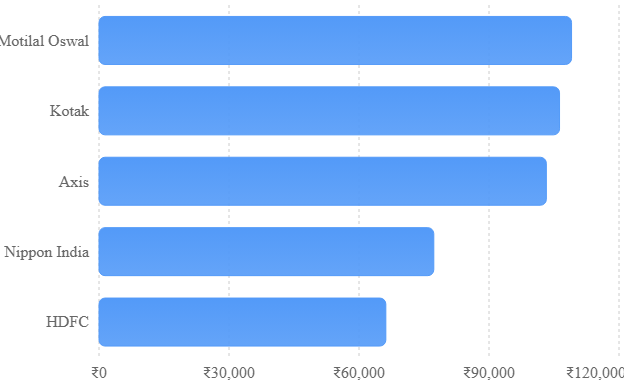
Source: Moneycontrol / ACE MF, October 28, 2026
Motilal Oswal Midcap Fund showed the largest absolute difference of ₹1,09,050. That amount is equivalent to more than 21 monthly SIP instalments of ₹5,000.
Kotak Mid Cap Fund followed with an additional ₹1,06,279, while Axis Midcap Fund generated ₹1,03,236 more through its direct plan.
Even the smallest difference, recorded in HDFC Mid Cap Fund, exceeded ₹66,000.
These differences demonstrate the long-term impact of investment expenses, rather than a difference in the underlying investment strategy.
Which Are India's Five Largest Midcap Mutual Funds?
According to the AUM figures dated September 30, 2026, the following funds were among the largest in India's midcap mutual fund category.
| Mutual Fund | Assets Under Management |
|---|---|
| HDFC Mid Cap Fund | ₹1,01,856.06 crore |
| Kotak Mid Cap Fund | ₹66,613.26 crore |
| Nippon India Growth Mid Cap Fund | ₹50,176.01 crore |
| Motilal Oswal Midcap Fund | ₹40,207.50 crore |
| Axis Midcap Fund | ₹33,527.80 crore |
AUM indicates the total value of assets managed by a mutual fund scheme. However, a larger AUM does not automatically mean better future performance.
Investors should also evaluate risk, investment objectives, consistency and costs before selecting a scheme.
Direct Plans Also Performed Better Over Five Years
The advantage of lower expenses was not limited to the 10-year SIP comparison.
Historical annualised five-year returns also showed direct plans outperforming regular plans across all five schemes.
| Mutual Fund | Direct Plan | Regular Plan |
|---|---|---|
| HDFC Mid Cap | 17.02% | 16.26% |
| Kotak Mid Cap | 14.53% | 13.27% |
| Nippon India Growth | 16.07% | 15.15% |
| Motilal Oswal Midcap | 18.41% | 17.22% |
| Axis Midcap | 11.87% | 10.66% |
Historical annualised returns reported for the period ending October 28, 2026.
Motilal Oswal Midcap Fund recorded the highest five-year annualised direct-plan return among the funds compared, at 18.41%.
However, strong historical performance does not ensure that the same fund will continue delivering similar returns in the future.
Are Direct Plans Always Better Than Regular Plans?
Direct plans generally provide a cost advantage, but the choice depends on the investor's knowledge and financial needs.
Investors who understand mutual funds and can independently manage asset allocation, fund selection and portfolio reviews may prefer direct plans.
Regular plans may suit investors who want ongoing assistance from a mutual fund distributor.
The additional cost of a regular plan should therefore be considered alongside the value of the services received.
Importantly, both plans remain exposed to market risks. A direct plan does not protect investors from losses when the underlying portfolio declines.
What Should You Check Before Starting an SIP in Your Wife's Name?
Starting a mutual fund SIP in a spouse's name can be part of a family's financial planning strategy.
However, investors should consider several important factors before proceeding.
First, select a mutual fund that matches the investment objective and risk tolerance of the account holder.
Second, compare the expense ratios of direct and regular plans rather than selecting a scheme only because of its past returns.
Third, understand that midcap mutual funds can experience significant market volatility. They are generally more suitable for investors who can tolerate fluctuations and maintain a long-term investment horizon.
Fourth, remember that investing in a spouse's name does not automatically eliminate tax obligations. Depending on the source of the money, India's income-tax clubbing provisions may apply to income or gains arising from investments funded through transfers between spouses.
Investors should consult a qualified tax professional where necessary.
The Biggest Lesson for Long-Term SIP Investors
The comparison of five leading midcap mutual funds highlights an important principle of wealth creation: investment costs matter.
A ₹5,000 monthly SIP maintained for 10 years resulted in a total contribution of ₹6 lakh. Historical data showed that the highest final portfolio value reached approximately ₹16.45 lakh.
More importantly, the direct plans generated between ₹66,194 and ₹1,09,050 more than the regular versions of the same schemes.
For investors planning to continue SIPs for 10, 15 or 20 years, understanding expense ratios can help them make more informed decisions.
Nevertheless, selecting a suitable fund, maintaining diversification and staying invested according to financial goals are equally important. SIP returns are market-linked, and there is no fixed formula that guarantees a particular maturity amount.
Disclaimer: This article is for educational and informational purposes only and does not constitute investment advice. Mutual fund investments are subject to market risks. Past performance is not a guarantee of future returns. Investors should read scheme-related documents carefully and consult a SEBI-registered investment adviser before making investment decisions.