Business
RBI Policy on October 7: Will Home Loan EMIs Rise and FD Rates Improve? Here's What to Expect
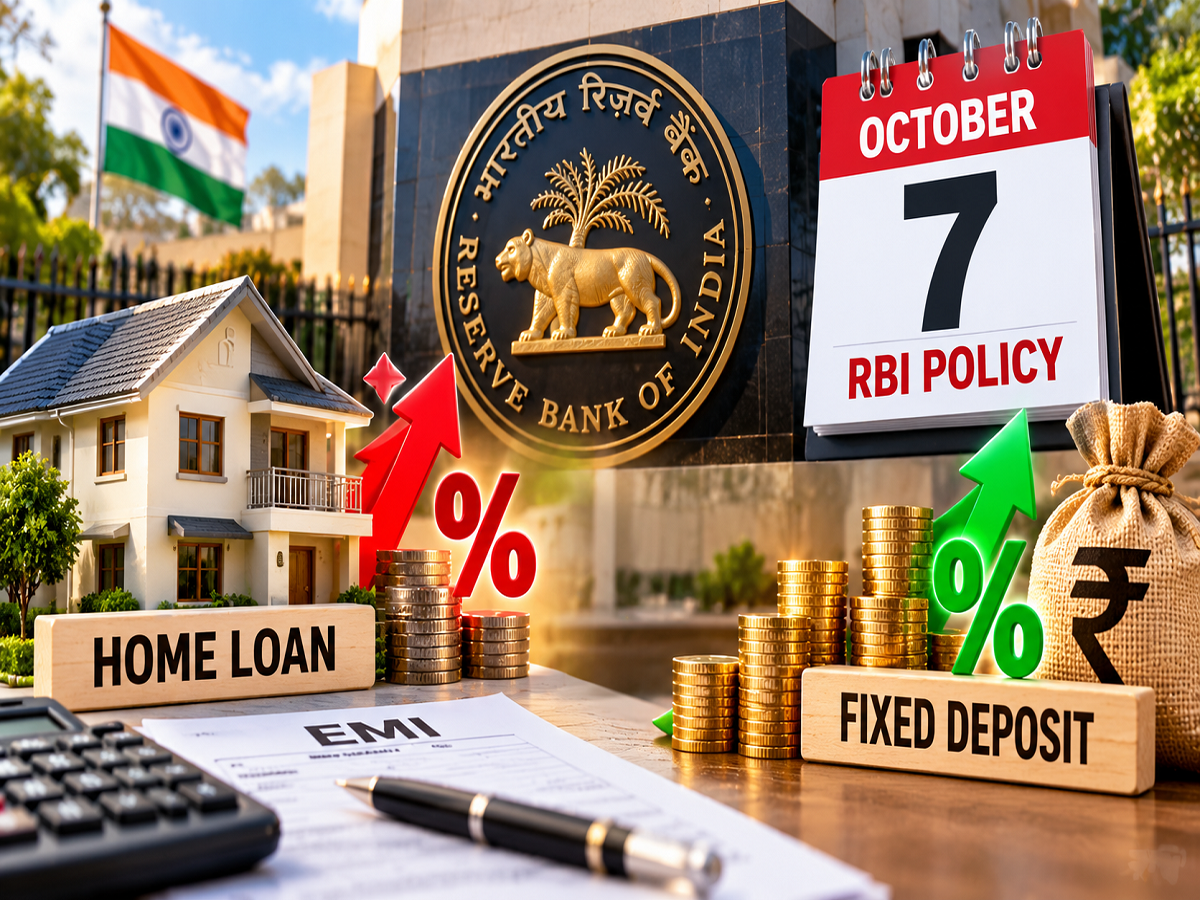
Borrowers and fixed-deposit investors will be closely watching the Reserve Bank of India’s upcoming monetary policy announcement on October 7, 2026. Expectations of a possible increase in the repo rate have put home loan EMIs, borrowing costs and bank deposit returns in focus.
The Monetary Policy Committee (MPC) is scheduled to announce the outcome of its policy review on October 7. According to estimates cited in the report, several economists and financial institutions expect the central bank to consider a 25-basis-point (bps) increase in the repo rate.
However, the rate increase has not yet been announced. The final decision will be known only after the RBI releases its monetary policy statement.
If the central bank does raise rates, borrowers with loans linked to external benchmarks could see higher borrowing costs. At the same time, people planning to open new fixed deposits may eventually benefit if banks increase their FD rates.
Could RBI Raise the Repo Rate by 25 Basis Points?
A poll of 19 economists, treasury heads and fixed-income experts cited in the report indicates that a majority expect the MPC to raise the repo rate by 25 basis points to 5.50%.
Four experts in the poll reportedly expect the RBI to leave the rate unchanged.
If a hike is announced, it would mark the first increase in the repo rate since February 2023, according to the report.
Some institutions also expect interest rates to move higher beyond the October meeting.
Union Bank of India expects the repo rate could reach somewhere between 5.75% and 6% during FY2027, while Japanese brokerage Nomura reportedly expects two 25-basis-point increases—one in October and another in December—which could take the terminal rate to 5.75%.
These remain forecasts rather than confirmed RBI decisions.
What Could a Repo Rate Hike Mean for Home Loan Borrowers?
A repo rate increase can be particularly important for borrowers whose loans are linked to external benchmarks such as the repo rate or an External Benchmark Lending Rate (EBLR).
If the benchmark increases and the lender passes the change on to borrowers, the applicable home loan interest rate could rise.
This could result in either a higher monthly EMI or a longer repayment period, depending on the lender's policy and the loan agreement.
The impact would therefore not necessarily be identical for every borrower.
₹50 Lakh Home Loan: How Much Could the EMI Increase?
The report provides an example to illustrate the potential impact.
Suppose a borrower has taken a ₹50 lakh home loan for 25 years at an interest rate of 7.5%.
The current monthly EMI is estimated at approximately ₹36,950.
If the interest rate increases by 25 basis points, the EMI could rise by around ₹817 per month, according to the calculation cited in the report.
Over the entire loan period, the borrower could end up paying approximately ₹2.45 lakh more in interest, assuming the relevant conditions used in the calculation remain unchanged.
| Loan Detail | Before Illustrative Rate Increase | After 25 bps Increase |
|---|---|---|
| Loan Amount | ₹50 lakh | ₹50 lakh |
| Original Tenure | 25 years | 25 years |
| Starting Interest Rate | 7.5% | 7.75%* |
| Approximate Current EMI | ₹36,950 | About ₹817 higher* |
| Possible Additional Interest | — | Around ₹2.45 lakh* |
*Illustrative figures based on the assumptions cited in the supplied report. The actual impact will depend on the lender's reset rules, outstanding principal, remaining tenure and applicable loan terms.
Will Your EMI Increase Immediately?
Not necessarily.
Even if the RBI raises the repo rate, the timing of the impact will depend on how the borrower's loan is structured and when the lender resets the applicable interest rate.
For repo-linked or other external-benchmark loans, rates may be revised according to the reset schedule specified by the lender.
Banks may respond to a higher rate by increasing the monthly EMI, extending the loan tenure or using a combination of the two, depending on the applicable terms.
Borrowers should therefore check their loan agreement rather than assuming their EMI will rise immediately after an RBI announcement.
How Can Borrowers Reduce the Impact?
A higher interest rate can become expensive over a long loan tenure because even a relatively small increase can add significantly to total interest payments.
One option borrowers can consider is voluntarily increasing their EMI, provided their budget allows it. Paying slightly more each month can help prevent the loan tenure from stretching substantially.
Periodic part-prepayments can also reduce the outstanding principal and potentially lower the overall interest burden.
However, borrowers should consider their emergency savings and other financial obligations before using large amounts of cash for prepayment.
Will FD Interest Rates Increase After an RBI Rate Hike?
A higher repo rate could create the possibility of better returns on new fixed deposits, but an RBI rate increase does not automatically mean every bank will raise FD rates by the same amount.
Banks decide their deposit rates based on several factors, including funding requirements, liquidity conditions, competition and their own balance-sheet strategy.
Therefore, even if the RBI raises the repo rate by 25 basis points, individual banks may respond differently.
Existing FD Investors May Not Get Higher Rates
People who already have fixed deposits should remember an important point: a standard FD generally continues at the interest rate agreed when the deposit was opened.
Suppose you already booked an FD at a particular rate. If your bank raises FD rates after the RBI policy decision, your existing deposit would normally continue earning its contracted rate until maturity, subject to the deposit's terms.
Higher rates would generally become relevant when opening a new FD or renewing a maturing deposit.
According to the example cited in the report, if a bank passes on the full 25-basis-point increase to depositors, a new ₹10 lakh FD could generate approximately ₹2,500 more in annual interest before tax.
The actual benefit would depend on the bank, deposit tenure and rate offered.
FD Laddering Could Help if Rates Continue to Rise
Investors expecting further increases in deposit rates may consider an FD laddering strategy instead of putting their entire investment into one long-term deposit.
Under this approach, money is divided among multiple FDs with different maturity dates.
For example, rather than locking the entire amount into one deposit, an investor could divide the money across shorter and longer tenures. As individual deposits mature, the proceeds can be reinvested at the prevailing rate.
This strategy can provide periodic liquidity while reducing the risk of locking the entire investment at one rate just before deposit rates potentially move higher.
However, future interest-rate increases are not guaranteed.
October 7 RBI Decision Will Be Crucial
The RBI's October 7 monetary policy announcement could have important implications for both borrowers and savers.
A 25-basis-point repo rate increase, if announced, could eventually make some floating-rate home loans more expensive. On the other hand, new FD investors could benefit if banks respond by raising deposit rates.
For now, a rate hike remains a market expectation rather than a confirmed decision. Borrowers should avoid changing their loan strategy solely on forecasts, while FD investors may want to compare deposit tenures and rates after the RBI's official announcement.
Disclaimer: This article is for general informational purposes only. Interest rates, EMIs and FD returns depend on individual banks, loan agreements, deposit terms and future RBI decisions. Consider your financial circumstances and seek professional advice before making borrowing or investment decisions.