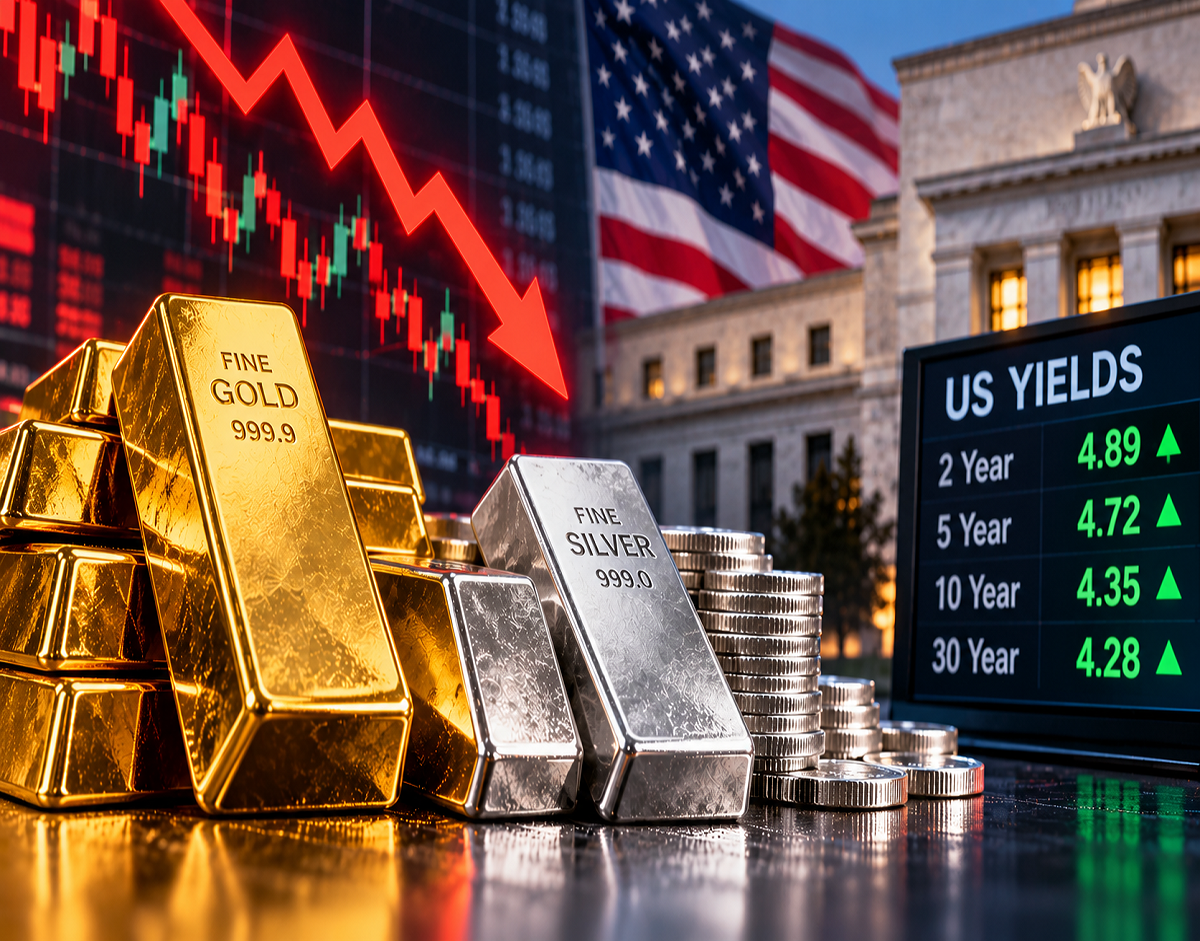
Gold and silver prices witnessed a sharp sell-off on Monday, September 28, as rising US Treasury yields, a stronger dollar and renewed inflation concerns put pressure on precious metals. The decline was visible in both domestic and international markets, with gold slipping below a key psychological level globally and silver recording an even steeper fall.
On the Multi Commodity Exchange (MCX), December gold futures fell ₹4,321, or 2.86%, to ₹1,46,789 per 10 grams. December silver futures declined ₹8,437, or 3.59%, to around ₹2.26 lakh per kilogram.
The weakness was not limited to India. In international trade, gold futures were down 2.37% at around $4,183.18 per ounce, while silver dropped 4.09% to approximately $61.66 per ounce.
The latest correction follows a strong run in precious metals and comes as investors reassess the outlook for US interest rates, inflation and geopolitical risks.
Why Are Gold and Silver Prices Falling?
One of the biggest factors weighing on bullion is the rise in US government bond yields.
Nirpendra Yadav, Senior Research Analyst at Bonanza, said gold's move below $4,200 per ounce reflects a change in the near-term macroeconomic environment. Higher crude oil prices have revived inflation concerns, which in turn are supporting US Treasury yields and the dollar.
This combination can be challenging for gold. Unlike bonds or fixed-income securities, gold does not provide regular interest income. When bond yields rise, the opportunity cost of holding a non-yielding asset such as gold can increase.
Expectations that the US Federal Reserve may need to maintain a restrictive monetary stance for longer have also added to the selling pressure.
Rising US Treasury Yields Put Bullion Under Pressure
Vedika Narvekar, Research Analyst for Commodities and Currencies at Anand Rathi Share and Stock Brokers, pointed to continued uncertainty surrounding the Strait of Hormuz as another important factor.
Oil prices have remained elevated amid geopolitical uncertainty, keeping inflation risks in focus. At the same time, the US 10-year Treasury yield has climbed to around 5.20%.
If inflation remains stubborn, markets could expect the Federal Reserve to keep monetary conditions tight. Such expectations can support the dollar and bond yields while creating headwinds for precious metals.
According to Narvekar's assessment, gold could remain under pressure until there is greater clarity over the situation involving Iran or Treasury yields begin to ease.
Gold Investors Should Track These Important Levels
After the sharp correction, traders are closely watching technical support and resistance zones.
In the international market, Narvekar identified approximately $4,110 per ounce as an important support area for gold. Resistance is seen near $4,300.
Yadav highlighted the $4,100-$4,070 range as another important zone to monitor. He also pointed to around $3,980 as a significant support level. A sustained move below this area, according to his assessment, could potentially increase selling pressure.
For domestic investors, ₹1.45 lakh per 10 grams has emerged as an important MCX gold support area.
Ashish Rajodia, Head of Commodities at PL Capital, identified support for MCX gold near ₹1.48 lakh and ₹1.46 lakh per 10 grams, while resistance is seen around ₹1.52 lakh and ₹1.55 lakh.
These levels are analysts' technical observations and should not be interpreted as guaranteed price targets.
Silver Falls More Sharply Than Gold
Silver also faced aggressive selling, with the MCX December contract falling to roughly ₹2.26 lakh per kilogram.
Gaurav Garg, Head of Research at Lemonn, said silver was trading at around $62.63 per ounce in the global market during the period referenced in the report. Like gold, silver is being affected by higher US yields and strength in the dollar.
However, silver typically experiences larger short-term price swings than gold because its demand is influenced by both investment activity and industrial consumption.
Vikram Subburaj, CEO of Giottus, noted that silver showed some recovery earlier in the session, highlighting its higher volatility relative to gold. He cautioned against drawing broad conclusions from movements during a single trading session.
US Inflation and Jobs Data Could Drive the Next Move
Several global factors could determine where gold and silver head next.
Investors are likely to closely monitor upcoming US inflation and employment data because both can influence expectations about Federal Reserve policy.
Treasury yields, the US Dollar Index and crude oil prices will also remain important. Any significant development involving the United States and Iran could quickly affect oil prices, inflation expectations and safe-haven demand.
For Indian buyers, movements in the rupee are another crucial factor.
Because international gold is generally priced in US dollars, a weaker rupee can make imported gold more expensive in India. As a result, a decline in international gold prices may not always translate into an equally large drop in domestic prices.
Could Lower Prices Bring Buyers Back?
The sharp fall could also influence demand in India's physical bullion and jewellery markets.
Darshan Desai, CEO of Aspect Bullion & Refinery, said jewellers and traders may remain cautious about inventory during periods of elevated volatility. However, a meaningful correction in prices could encourage some buyers to return.
The approaching festive and wedding season could provide additional support to physical demand, although buying patterns will ultimately depend on prices and consumer sentiment.
What Should Gold and Silver Investors Watch Now?
Instead of focusing only on the size of Monday's decline, investors may need to watch the factors driving the broader trend.
US inflation and employment reports, Treasury yields, movements in the dollar, crude oil prices and geopolitical developments are likely to remain major triggers for bullion. Indian investors should additionally monitor the rupee-dollar exchange rate.
Subburaj suggested in the source report that long-term buyers could consider staggered purchases rather than reacting to short-term price swings. For leveraged traders, he stressed the importance of smaller positions and disciplined stop-loss strategies.
With gold and silver experiencing significant volatility, the next direction may depend less on a single trading session and more on how inflation, interest-rate expectations, oil prices and geopolitical developments evolve over the coming days.
Disclaimer: The support and resistance levels and market observations mentioned above reflect the views of analysts cited in the source material. They are not guaranteed forecasts or investment recommendations. Gold, silver and other market-linked investments carry risk. Investors should consider their financial circumstances and consult a qualified financial adviser before making investment decisions.