Business
EPFO Interest Rules 2026: Retiring Before or After 55? Know How Long Your PF Balance Earns Interest
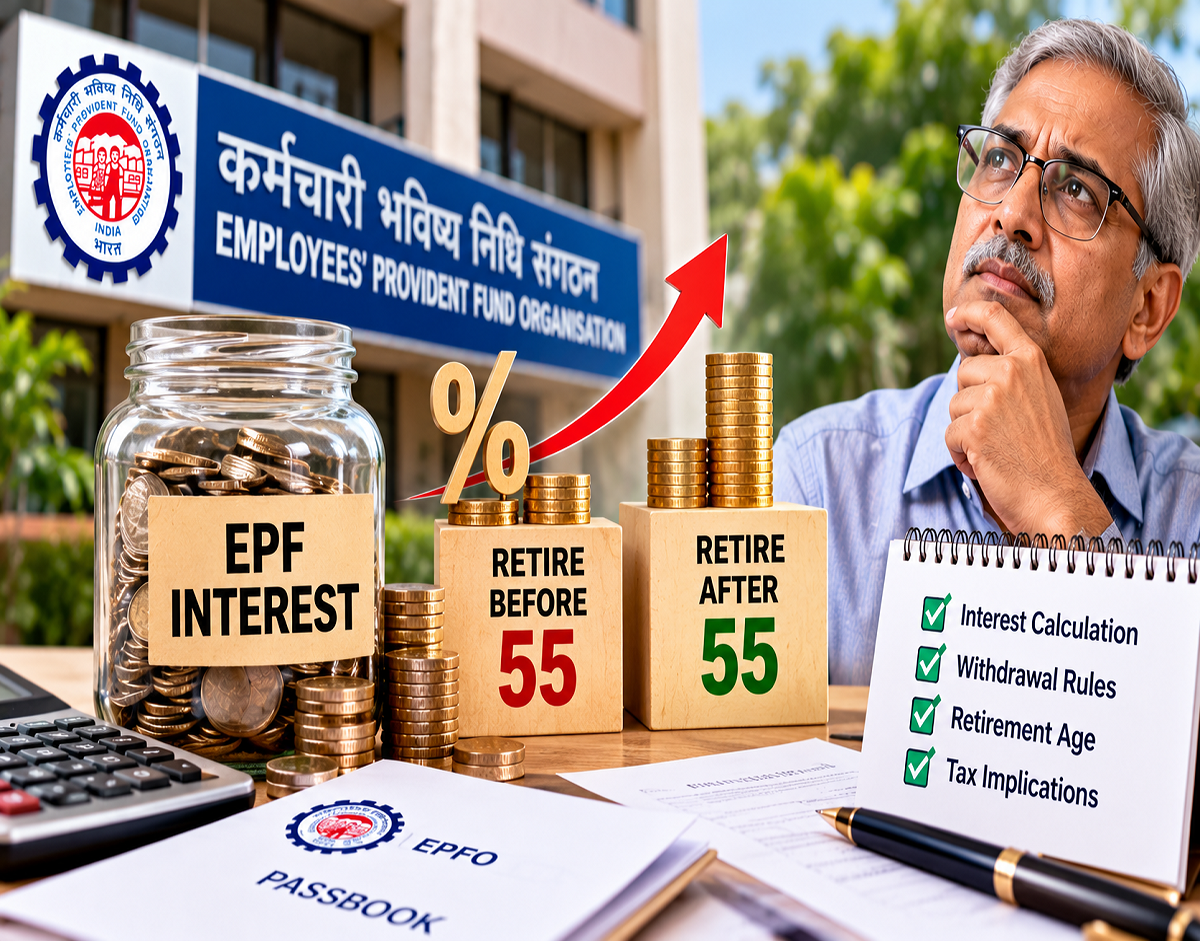
EPFO PF Interest Rules 2026: Retirement planning involves more than calculating your pension and savings. Employees should also understand what happens to their Employees' Provident Fund (EPF) balance after leaving their jobs. One common question is whether the money remaining in a PF account continues earning interest after retirement. The answer depends on several factors, including the employee's age, employment status and the rules governing inoperative EPF accounts.
EPFO Interest After Retirement: What Should Employees Know?
The Employees' Provident Fund Organisation (EPFO) manages retirement savings for millions of employees across India.
During employment, eligible employees and employers contribute to the provident fund system according to applicable rules.
The EPF balance earns interest at the rate declared for the relevant financial year.
However, many employees are uncertain about what happens when they stop working.
Some believe that PF interest stops immediately after retirement, while others assume that their savings will continue earning interest indefinitely.
Neither assumption is universally correct.
The treatment of interest depends on the circumstances in which contributions stop and the provisions of the Employees' Provident Funds Scheme, 1952.
Understanding these rules can help employees make informed decisions about retaining, transferring or withdrawing their provident fund savings.
What Happens if You Retire Before Turning 55?
Employees who leave employment or retire before the age of 55 may have different considerations from those who retire later.
According to the October 2026 report, employees retiring before 55 may continue earning interest on their existing PF balance until the age of 58, subject to applicable EPFO provisions.
For example, consider an employee who retires at 52.
Even if the employee stops making fresh contributions, the amount already accumulated in the EPF account may continue earning interest for a further period.
However, the precise treatment depends on the member's employment circumstances and the rules applicable to the account.
It is important not to assume that every person leaving employment before 55 will automatically receive interest until their 58th birthday.
Voluntary resignation, unemployment, early retirement and other employment situations may be treated differently under relevant provisions.
Members should verify the applicable rules before deciding to leave their funds untouched for several years.
What if an Employee Retires at 55 or Later?
The position may differ for employees who retire after reaching 55.
Under the EPF Scheme, the circumstances in which contributions stop and the time elapsed since the relevant event can affect when an account becomes inoperative.
The report discusses the possibility of interest continuing for a specified period after retirement.
However, employees should not assume that interest will necessarily continue for exactly three years in every case.
For instance, an employee retiring at 56 should not automatically conclude that interest will stop at 58 or continue indefinitely.
The relevant EPFO provisions, account status and circumstances of retirement must be considered.
Members who continue working in EPF-covered employment after 55 may also be in a different position from those who have permanently stopped working.
How Long Does EPFO Pay Interest After Retirement?
The distinction between a contributing account and an inoperative account is important when understanding post-retirement interest.
The EPF Scheme contains specific provisions concerning accounts in which contributions have stopped.
These provisions address circumstances such as retirement, cessation of employment and other situations covered by the scheme.
In particular, the rules governing inoperative accounts can affect whether interest continues to be credited.
A member should therefore consider both the reason contributions stopped and the relevant age-related conditions.
The following table summarizes the general issues employees should examine.
| Employment Situation | Important PF Interest Consideration |
|---|---|
| Retirement before age 55 | Interest may continue, depending on applicable rules and account status |
| Retirement at age 55 or later | Retirement-related provisions and inoperative account rules become relevant |
| Leaving a job before retirement | Treatment depends on employment status and applicable EPFO provisions |
| Continuing in EPF-covered employment | Contributions and interest generally continue under scheme rules |
| Account becomes inoperative | Interest treatment depends on the applicable inoperative account provisions |
The table is a general explanation rather than an individual determination of interest eligibility.
What Is an Inoperative EPF Account?
An inoperative EPF account is an account that meets the conditions specified under the Employees' Provident Funds Scheme.
An account does not necessarily become inoperative simply because no fresh contribution has been received for a short period.
The rules consider specified circumstances and time periods.
This distinction is important because employees sometimes use the terms inactive, inoperative and closed interchangeably.
However, these terms do not necessarily have the same meaning under EPFO procedures.
An inoperative account does not mean that the member's accumulated provident fund balance has been confiscated.
The money remains subject to the relevant EPF Scheme provisions, and eligible members or claimants may seek settlement through the prescribed process.
Nevertheless, interest treatment should be verified separately.
Does EPFO Stop Paying Interest Immediately After You Leave Your Job?
Not necessarily.
Leaving employment does not automatically mean that the accumulated PF balance stops earning interest on the same day.
The relevant rules determine when interest may continue and when it may cease.
Employees who leave one company and join another EPF-covered establishment may also be able to transfer their accumulated balance to the new member account.
In such situations, transferring the balance can help consolidate retirement savings and simplify account management.
However, employees who remain unemployed for an extended period should check the specific provisions applicable to their circumstances.
It is advisable to avoid relying on generalized claims that every account earns interest for three years after contributions stop.
EPFO Interest Rate: How Is PF Interest Calculated?
EPF interest is calculated according to the rate applicable for the relevant financial year and the scheme's prescribed calculation method.
The interest rate is not permanently fixed for the entire period of an employee's membership.
It is determined through the applicable annual process.
Interest is generally calculated on eligible monthly running balances and credited according to EPFO procedures.
For illustration, suppose a member has an eligible balance of ₹5 lakh and an annual interest rate of 8.25% applies for a full year.
A simple annual calculation would produce:
₹5,00,000 × 8.25% = ₹41,250
This is only an illustration.
The actual amount credited may differ depending on monthly balances, withdrawals, contributions, the applicable annual rate and the period for which interest is payable.
Members should consult their EPF passbooks for actual interest credits.
How to Check Your PF Balance and Interest Online
EPFO provides digital services that allow members to review their provident fund records.
Members can generally check their passbook through the official EPFO passbook service.
Step-by-Step Guide
- Visit the official EPFO website.
- Open the member passbook service.
- Sign in using your Universal Account Number (UAN) and the required credentials.
- Select the relevant member ID.
- Review the available contribution and interest records.
- Download or save the passbook for future reference.
The passbook may show employee contributions, employer contributions allocated to EPF and interest entries.
Members should note that a delayed annual interest entry does not, by itself, establish that the account has stopped earning interest.
If records appear incorrect, the member can seek clarification through official EPFO grievance channels.
Should You Withdraw Your PF Balance Immediately After Retirement?
The decision to withdraw provident fund savings depends on individual financial circumstances and the applicable withdrawal rules.
Some employees may need access to their accumulated funds for retirement expenses, healthcare or other essential requirements.
Others may prefer to retain eligible funds for a period while evaluating their retirement income options.
Before deciding, employees should consider the interest eligibility of their account, their immediate financial needs and any applicable tax implications.
They should also distinguish between EPF savings and benefits available under the Employees' Pension Scheme (EPS), which operates under separate rules.
The appropriate decision can vary significantly between individuals.
What Should Employees Do Before Turning 55 or 58?
Employees approaching retirement should review their EPFO records well in advance.
They should ensure that their personal details, employment history and bank information are accurate.
It is also useful to confirm whether all previous PF accounts have been properly transferred or settled.
Members who have worked for several employers may have multiple member IDs associated with their UAN.
Checking these records can help identify missing transfers or other discrepancies.
Employees should also verify the applicable withdrawal and interest provisions rather than relying solely on their age.
Where the rules are unclear, clarification from EPFO can help prevent costly assumptions.
EPFO PF Interest Rules 2026: Key Takeaway for Retiring Employees
Provident fund savings can remain an important financial resource after an employee leaves the workforce.
However, interest on an EPF account does not necessarily continue indefinitely.
The period for which interest is payable depends on the circumstances of retirement or cessation of employment and the provisions governing the account.
Employees retiring before 55 and those retiring at 55 or later may need to consider different regulatory conditions.
The most important point is that retirement does not automatically stop PF interest immediately, but neither does it guarantee interest for life.
Before withdrawing or retaining their EPF balance, members should review their passbook and confirm the applicable rules through EPFO's official channels.
Disclaimer: This article provides general information about EPFO interest and retirement-related account rules. The exact period of interest eligibility depends on the applicable EPF Scheme provisions and individual account circumstances. Members should seek official clarification before making retirement or withdrawal decisions.