Business
8th Pay Commission Salary Hike: How a 2.1 Fitment Factor Could Raise Minimum Basic Pay to ₹37,800
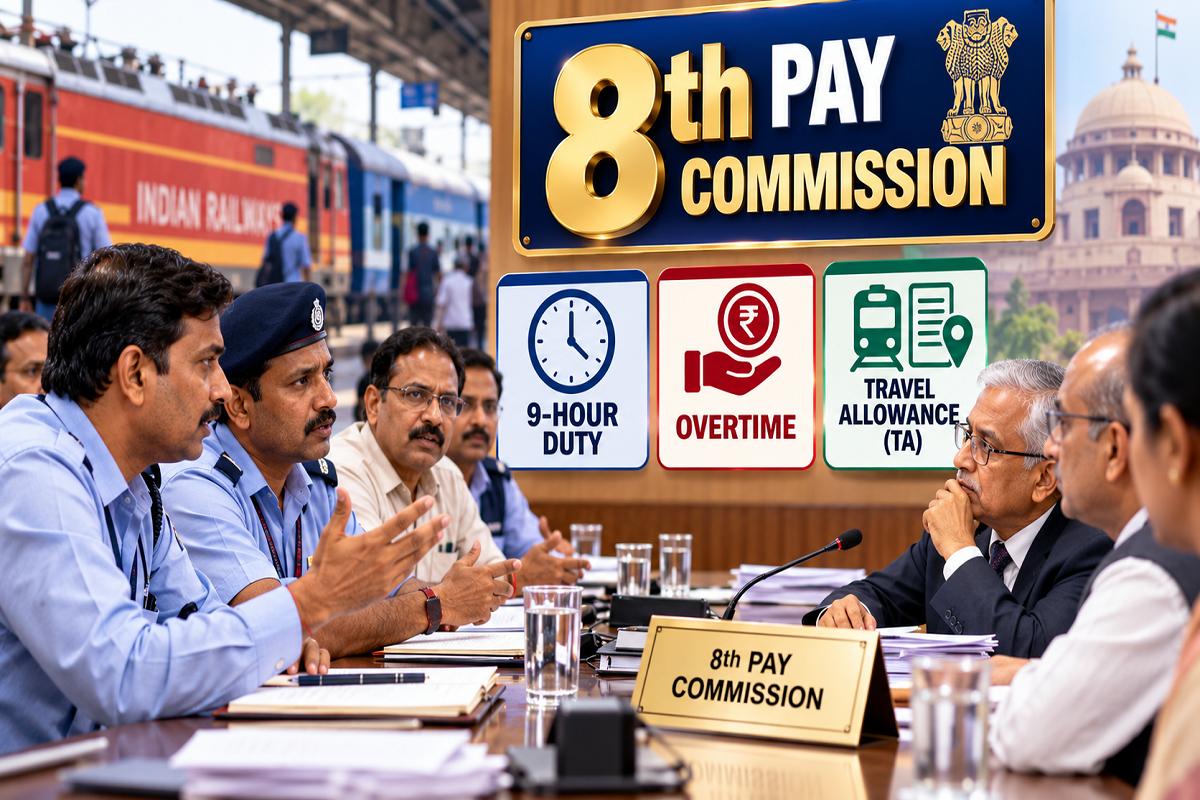
8th Pay Commission Latest Update, October 12, 2026: Central government employees and pensioners are closely following discussions surrounding the 8th Central Pay Commission, particularly the fitment factor that could determine their revised salaries and pensions.
While employee organisations have reportedly demanded fitment factors ranging from 2.7 to 4.0, discussions have also emerged around a comparatively lower multiplier of 2.1.
At first glance, a fitment factor of 2.1 may appear disappointing because the 7th Pay Commission used a multiplier of 2.57. However, comparing these two figures without considering existing Dearness Allowance (DA) can give an incomplete picture of the potential financial benefits.
Under a hypothetical 2.1 fitment factor, an employee currently receiving a minimum basic salary of ₹18,000 would see the revised basic pay increase to ₹37,800.
However, the 2.1 fitment factor has not been confirmed as an approved recommendation, and the final salary increase will depend on the government's decisions, the applicable DA at the time of implementation, and the revised allowance structure.
What Is the Fitment Factor in the 8th Pay Commission?
The fitment factor is a multiplier used to calculate revised basic pay when a new government pay structure is introduced.
It helps convert an employee's existing basic salary into the new pay framework.
The calculation is straightforward:
Revised Basic Pay = Existing Basic Pay × Fitment Factor
For example, if an employee currently receives ₹18,000 as basic salary and a fitment factor of 2.1 is applied, the calculation would be:
₹18,000 × 2.1 = ₹37,800
This would represent a 110% increase in the basic pay figure.
However, this does not mean the employee's total monthly salary or take-home income would automatically increase by 110%.
The distinction is important because existing DA and other allowances must be considered when calculating the actual financial benefit.
7th Pay Commission vs 8th Pay Commission: Why a Lower Fitment Factor May Still Offer Benefits
The 7th Central Pay Commission introduced a fitment factor of 2.57.
Before its implementation, the minimum basic pay for central government employees was ₹7,000.
Applying the multiplier produced the following calculation:
₹7,000 × 2.57 = ₹17,990
The revised minimum basic salary was consequently fixed at ₹18,000.
However, employees were already receiving Dearness Allowance under the previous pay structure.
This means the difference between the old basic pay and the revised basic pay did not represent the entire increase in monthly earnings.
A similar approach is necessary when estimating salary revisions under the 8th Pay Commission.
Understanding the 7th Pay Commission Salary Calculation
The supplied report uses a Dearness Allowance rate of 125% to illustrate the transition from the previous pay structure.
Under that assumption, an employee receiving ₹7,000 as basic pay would have received:
| Salary Component | Amount |
|---|---|
| Previous basic pay | ₹7,000 |
| DA at 125% | ₹8,750 |
| Basic pay plus DA | ₹15,750 |
| Revised basic pay under 7th CPC | ₹18,000 |
| Difference | ₹2,250 |
The calculation shows an increase of ₹2,250 when comparing the revised basic pay with the previous basic pay plus DA.
That is approximately 14.29% of the earlier basic-plus-DA amount, not 32%.
The ₹2,250 difference represents about 32.14% of the old ₹7,000 basic salary, which is a different comparison.
The actual salary revision would also depend on changes to allowances and deductions.
8th Pay Commission Salary Calculation With a 2.1 Fitment Factor
Now consider an employee whose existing minimum basic pay is ₹18,000.
If the government were to approve a fitment factor of 2.1, the revised basic salary would become ₹37,800.
The supplied report uses a hypothetical comparison based on DA of 58%.
Illustrative salary calculator
Current basic salary (₹)
Assumed fitment factor
2.10
2.57
2.86
Assumed current DA
58%
Illustrative revised basic pay
₹37,800
Existing basic + DA
₹28,440
Difference before revised allowances and deductions
+₹9,360
32.91% compared with existing basic pay plus DA
This calculator illustrates possible pay fixation, not an officially approved 8th CPC salary or take-home amount.
Using the article's assumptions, the existing basic pay plus DA would be ₹28,440, compared with a proposed new basic pay of ₹37,800.
That produces an illustrative increase of ₹9,360 per month, or approximately 32.91% over the existing basic-plus-DA figure.
The source article rounds the revised basic pay to ₹38,000 and consequently arrives at a ₹9,560 difference. However, the exact multiplication gives ₹37,800.
8th Pay Commission Salary Chart: What Different Fitment Factors Could Mean
Employees at different pay levels may experience different absolute increases in their basic salaries.
The following table shows hypothetical revised basic pay under three possible fitment factors.
| Current Basic Pay | Factor 2.10 | Factor 2.57 | Factor 2.86 |
|---|---|---|---|
| ₹18,000 | ₹37,800 | ₹46,260 | ₹51,480 |
| ₹25,500 | ₹53,550 | ₹65,535 | ₹72,930 |
| ₹35,400 | ₹74,340 | ₹90,978 | ₹1,01,244 |
| ₹44,900 | ₹94,290 | ₹1,15,393 | ₹1,28,414 |
| ₹56,100 | ₹1,17,810 | ₹1,44,177 | ₹1,60,446 |
These figures are mathematical illustrations only. They are not an official 8th Pay Commission pay matrix. Actual pay fixation may involve rounding rules, revised pay levels, and other government-approved provisions.
Why Dearness Allowance Matters in Salary Revision
Dearness Allowance is provided to eligible government employees to help offset the impact of inflation.
It is generally revised periodically using the applicable inflation-linked formula.
When a new pay commission is implemented, the treatment of accumulated DA becomes a major consideration.
A new pay structure may incorporate the impact of existing DA into revised basic salaries, while DA under the new structure may begin from a fresh base.
This is why a fitment factor should not be interpreted as a direct percentage increase in take-home salary.
For example, multiplying an existing basic salary by 2.1 creates a basic-pay increase of 110%.
However, if the employee was already receiving substantial DA, the increase compared with existing basic pay plus DA would be considerably smaller.
Will Take-Home Salary Increase After the 8th Pay Commission?
A revised basic salary can influence several components of a government employee's compensation.
These may include House Rent Allowance (HRA), Transport Allowance (TA), Dearness Allowance, and other eligible benefits.
However, the actual effect will depend on how these components are revised under the new pay structure.
Employees should also remember that higher basic pay can affect deductions and contributions.
For example, retirement-related contributions and applicable income tax deductions may change with salary revisions.
Therefore, the increase in gross salary may not be identical to the increase in take-home pay.
The final amount received in an employee's bank account will depend on both earnings and deductions.
What Are Employee Organisations Demanding?
Various employee associations have reportedly submitted or discussed proposals for higher fitment factors.
The supplied report refers to demands ranging from approximately 2.7 to 4.0.
These demands reflect expectations for improved compensation, but they should not be confused with recommendations formally accepted by the government.
The report also refers to discussions involving the All India NPS Employees Federation about the possible financial impact of a 2.1 multiplier.
As of the supplied October 12 update, the 2.1 figure remains a hypothetical scenario rather than a confirmed final fitment factor.
What Could the 8th Pay Commission Mean for Pensioners?
The 8th Central Pay Commission is also important for central government pensioners.
Any approved revision to the pension framework could influence the basic pension received by eligible retirees.
However, pension calculations may involve separate rules concerning pension fixation, Dearness Relief, and applicable government orders.
It would therefore be inaccurate to assume that every pensioner will receive an increase identical to the salary calculations shown for serving employees.
Pensioners will need to wait for the final recommendations and official implementation instructions.
When Could the 8th Pay Commission Report Be Released?
According to the supplied report, the 8th Central Pay Commission was formally constituted in November 2025 and given an 18-month period to prepare its recommendations.
On that timeline, its report could be submitted around May 2027.
However, the expected submission date should not be confused with the date on which revised salaries will begin appearing in employees' accounts.
The government would need to examine the recommendations, decide which proposals to accept, and issue the necessary implementation orders.
Any decision concerning retrospective applicability or arrears would also require official confirmation.
8th Pay Commission Latest Update: What Should Employees Remember?
The debate surrounding the 8th Pay Commission shows why the fitment factor alone cannot determine the true benefit of a salary revision.
A multiplier of 2.1 is numerically lower than the 7th Pay Commission's 2.57, but it could still produce a meaningful increase in basic salary.
For an employee currently earning ₹18,000 in basic pay, the hypothetical 2.1 calculation produces a revised basic salary of ₹37,800.
Using the supplied assumption of 58% DA, the difference between the proposed revised basic pay and existing basic pay plus DA would be ₹9,360.
The most important point is that this is not a confirmed salary hike. The final benefit will depend on the approved fitment factor, DA treatment, allowance revisions, deductions, and the government's implementation decisions.
Until the official pay matrix is released, employees and pensioners should treat circulating salary charts as estimates rather than guaranteed payments.
Disclaimer: All salary calculations in this article are illustrative. The fitment factors discussed are hypothetical or reported demands, not confirmed government decisions. The 58% DA rate is used solely as an assumption from the supplied article and has not been independently verified as the applicable October 2026 rate.