Business
8th Pay Commission 2026: Expected Salary Hike, DA, Pension, Pay Matrix and Implementation Timeline Explained
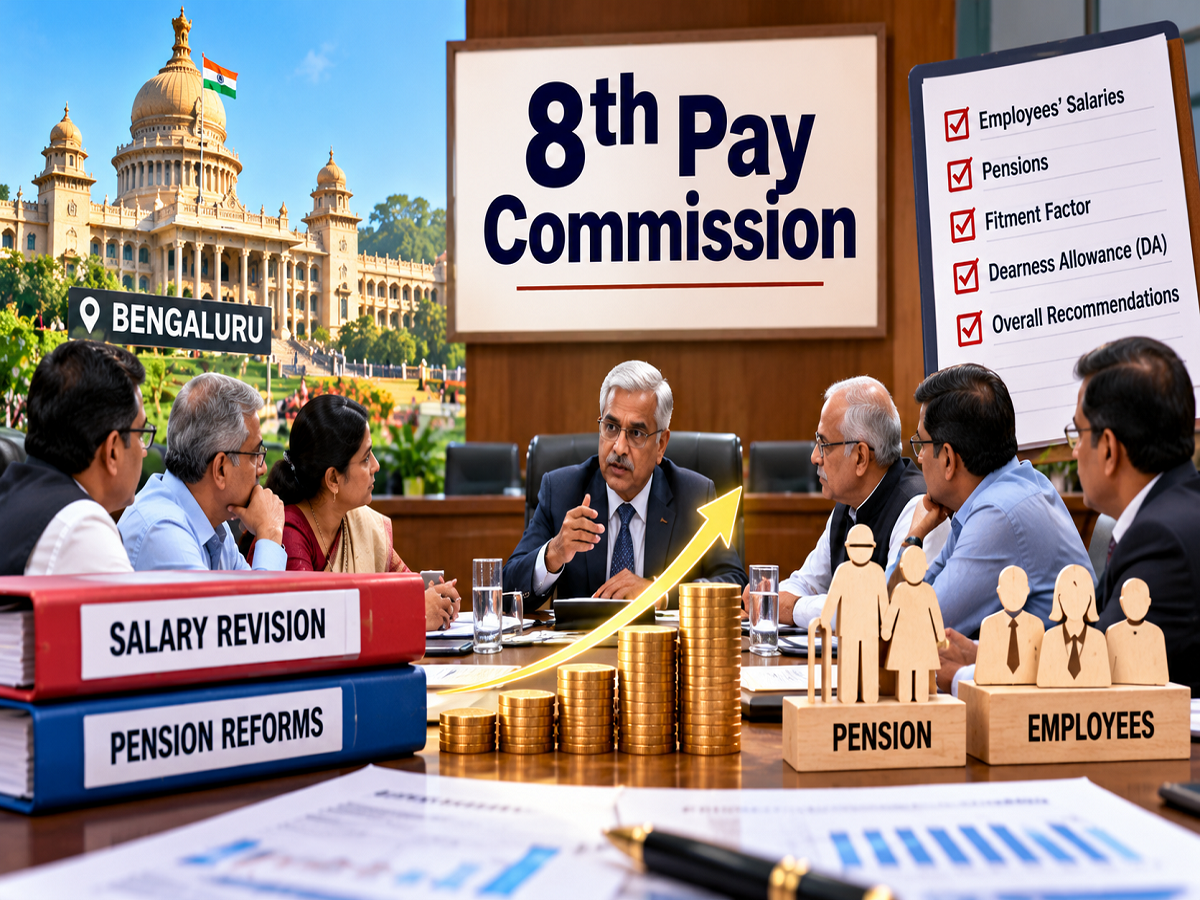
8th Pay Commission Latest News, October 13, 2026: Central government employees and pensioners are closely watching developments surrounding the 8th Central Pay Commission as discussions about salary revisions, allowances, pensions, and retirement benefits continue. An important consultation meeting is reportedly scheduled in Mumbai later this month, where employee organisations, pensioners' associations, and other representatives are expected to present their recommendations.
The commission's proposals could influence the financial future of more than one crore serving and retired central government personnel. However, the final salary increase, revised pay matrix, fitment factor, and implementation schedule have not yet been established in the information provided.
A major question among employees is whether the expected salary revision could begin in 2027 or whether the complete financial benefits might take longer to reach their accounts.
Here is a detailed explanation of the reported developments, the commission's responsibilities, and the possible implications for salaries and pensions.
8th Pay Commission: Important Meeting Expected in Mumbai
The consultation process surrounding the 8th Pay Commission is reportedly gaining momentum.
According to the supplied report, a significant meeting is expected to take place in Mumbai towards the end of October 2026.
Representatives of central government employee unions, pensioners' associations, and various federations are expected to discuss important financial and service-related demands.
The discussions may cover basic salary structures, annual increments, promotion-related benefits, Dearness Allowance, Dearness Relief, House Rent Allowance, and pension provisions.
However, consultation meetings do not automatically result in final government approval. The commission must examine the representations, prepare its recommendations, and submit its report for consideration.
How Many Employees and Pensioners Could Benefit?
The 8th Central Pay Commission is expected to have implications for a large number of central government employees and retirees.
The supplied report estimates that approximately 50 lakh serving employees and around 65 lakh pensioners could be affected by the eventual recommendations.
These groups include personnel associated with central government departments, the railways, defence services, and other eligible organisations.
The actual financial benefits will depend on the government's final decisions, the applicable service rules, and the categories of employees and pensioners covered.
What Are the Terms of Reference of the 8th Pay Commission?
The Terms of Reference, commonly known as the ToR, establish the areas that a pay commission is expected to examine before submitting recommendations.
According to the supplied information, the 8th Pay Commission was constituted on November 3, 2025, with a chairperson, a part-time member, and a member-secretary.
The commission has reportedly been given 18 months to complete its work, with the possibility of submitting an interim report if necessary.
The ToR requires consideration of several important issues, including the country's economic conditions, fiscal discipline, government expenditure, development priorities, and the long-term financial implications of revised compensation.
The commission is also expected to consider the potential impact of its recommendations on state government finances.
8th Pay Commission Salary Hike: What Changes Are Expected?
One of the most closely followed aspects of the 8th Pay Commission is the possible revision of basic salaries.
The commission is expected to review the existing pay structure and examine whether changes are necessary to maintain fair compensation across different levels of government service.
The review may include:
- Revision of basic pay and the existing pay matrix.
- Examination of annual increment provisions.
- Review of promotion-related financial benefits.
- Rationalisation of allowances and other employment benefits.
- Measures to improve compensation competitiveness and administrative efficiency.
The actual percentage increase in salaries cannot be determined until the relevant recommendations and government decisions are available.
What Could Happen to the Fitment Factor?
The fitment factor is an important component of pay revision discussions because it can be used to calculate revised basic salaries.
Employee organisations may recommend different multiplication factors based on their assessment of inflation, compensation needs, and pay disparities.
For illustration, consider an employee with a current basic salary of ₹18,000.
| Illustrative Fitment Factor | Calculated Revised Basic Pay |
|---|---|
| 2.00 | ₹36,000 |
| 2.28 | ₹41,040 |
| 2.57 | ₹46,260 |
| 2.86 | ₹51,480 |
| 3.00 | ₹54,000 |
Important: These figures are hypothetical calculations, not approved 8th Pay Commission salary rates. A revised basic pay figure also does not represent the same percentage increase in total take-home salary, because the treatment of existing allowances must be considered.
No particular fitment factor should be presented as final without an official decision.
Dearness Allowance and Dearness Relief: What Could Change?
Dearness Allowance (DA) helps eligible serving government employees manage the effects of inflation.
Dearness Relief (DR) performs a similar function for eligible pensioners.
The 8th Pay Commission may examine how these components should operate within a revised compensation structure.
One important question is how the DA accumulated under the existing pay structure will be treated when a new basic pay system is introduced.
Past pay revisions have involved adjustments to the relationship between basic pay and inflation-linked allowances.
However, employees should not assume that the existing DA will be added separately to a newly calculated basic salary without considering the final approved methodology.
Until new rules are implemented, applicable DA and DR payments continue to be governed by the prevailing government orders.
Will House Rent Allowance and Other Benefits Increase?
House Rent Allowance (HRA) is another important component of compensation for eligible central government employees.
The commission may review HRA structures, city classifications, eligibility conditions, and the relationship between housing costs and employee compensation.
Other allowances may also be examined to determine whether they remain relevant and appropriately structured.
The commission's review could involve rationalising existing benefits rather than simply increasing every allowance.
Any change in HRA or other allowances would depend on the recommendations ultimately accepted by the government.
Annual Salary Increments and Promotion Benefits Under Review
Central government employees also have expectations concerning annual increments and career progression.
The commission's mandate includes examining the salary structure in a manner that supports efficiency, accountability, and the recruitment and retention of capable personnel.
Employee organisations may seek improvements in increment rates and financial progression opportunities.
The existing compensation system also includes promotion-related provisions and other service benefits that may be reviewed.
However, a higher annual increment rate has not been confirmed merely because employee groups have submitted demands.
8th Pay Commission Pension Update: What Retirees Can Expect
Pensioners are another major group awaiting the commission's recommendations.
The review is expected to consider retirement-related benefits and relevant pension arrangements for eligible central government personnel.
The supplied report refers to the National Pension System (NPS), Unified Pension Scheme (UPS), and employees covered by other applicable pension provisions.
Important areas of examination may include pension-related benefits, gratuity arrangements, and the financial implications of different retirement systems.
The eventual recommendations could have implications for both current employees approaching retirement and eligible existing pensioners.
Nevertheless, the final treatment of each pension category will depend on the commission's report and the government's subsequent decisions.
Will Gratuity Rules Also Change?
Gratuity is an important retirement benefit for eligible employees.
The 8th Pay Commission may examine gratuity-related provisions alongside other retirement benefits.
This review could involve assessing existing limits, eligibility conditions, and the relationship between salary revisions and retirement payouts.
However, there is no basis in the supplied information to announce a specific new gratuity ceiling or revised payment formula.
Employees should wait for official recommendations before making retirement calculations based on assumed changes.
When Will the 8th Pay Commission Submit Its Report?
According to the reported timeline, the commission was constituted on November 3, 2025, and was given 18 months to submit its recommendations.
On that basis, the expected reporting deadline falls around early May 2027.
The commission may submit recommendations earlier, or an interim report may be issued if permitted under its terms.
The supplied article suggests that recommendations could emerge between February and April 2027, although this remains an expectation rather than a confirmed announcement.
The submission of the report would be an important milestone, but it would not automatically mean revised salaries would begin immediately.
8th Pay Commission Implementation: Will Employees Have to Wait Until 2030?
A major concern among central government employees is the possibility of a lengthy gap between the commission's recommendations and the actual payment of revised salaries.
The process generally involves several stages, including examination of the report, government approval, notification of revised rules, and administrative implementation.
The supplied article raises the possibility that the complete financial effects of the new pay structure could extend into 2029 or 2030.
However, there is no confirmed implementation date of 2029 or 2030 in the information provided.
It is also important to distinguish between the effective date of a pay revision and the date on which revised payments or arrears are disbursed.
These dates may differ depending on the government's final decisions.
Why Must the Government Consider Financial Conditions?
Revising salaries and pensions for a large workforce can create substantial recurring expenditure.
The commission is therefore expected to consider the government's fiscal position, public welfare commitments, development spending, and long-term pension liabilities.
The financial effects on state governments may also be relevant because some states choose to adopt or adapt central pay revision recommendations.
The objective is to examine employee compensation while considering the broader sustainability of public finances.
8th Pay Commission Latest Update: What Employees Should Watch Next
The upcoming consultation process could provide greater clarity about the demands being placed before the commission.
Employees and pensioners will be watching developments concerning the fitment factor, revised pay matrix, DA and DR treatment, pension arrangements, gratuity, annual increments, and implementation dates.
However, proposals submitted by employee associations should not be confused with recommendations formally issued by the commission or decisions approved by the Union government.
The most important development will be the publication of the commission's recommendations and the government's official response. Until then, any specific salary increase, pension revision, or implementation date should be treated as provisional.
For now, the reported 18-month timeline points towards a possible report in 2027, but the date when employees will actually receive revised pay remains uncertain.
Editorial verification note: This article is an original English rewrite of the supplied October 13, 2026 report. The Mumbai meeting, commission timeline, membership details, and other current procedural claims have not been independently checked against official government notifications. Salary examples are illustrative, and no fitment factor, revised pay scale, or implementation date is presented as approved.